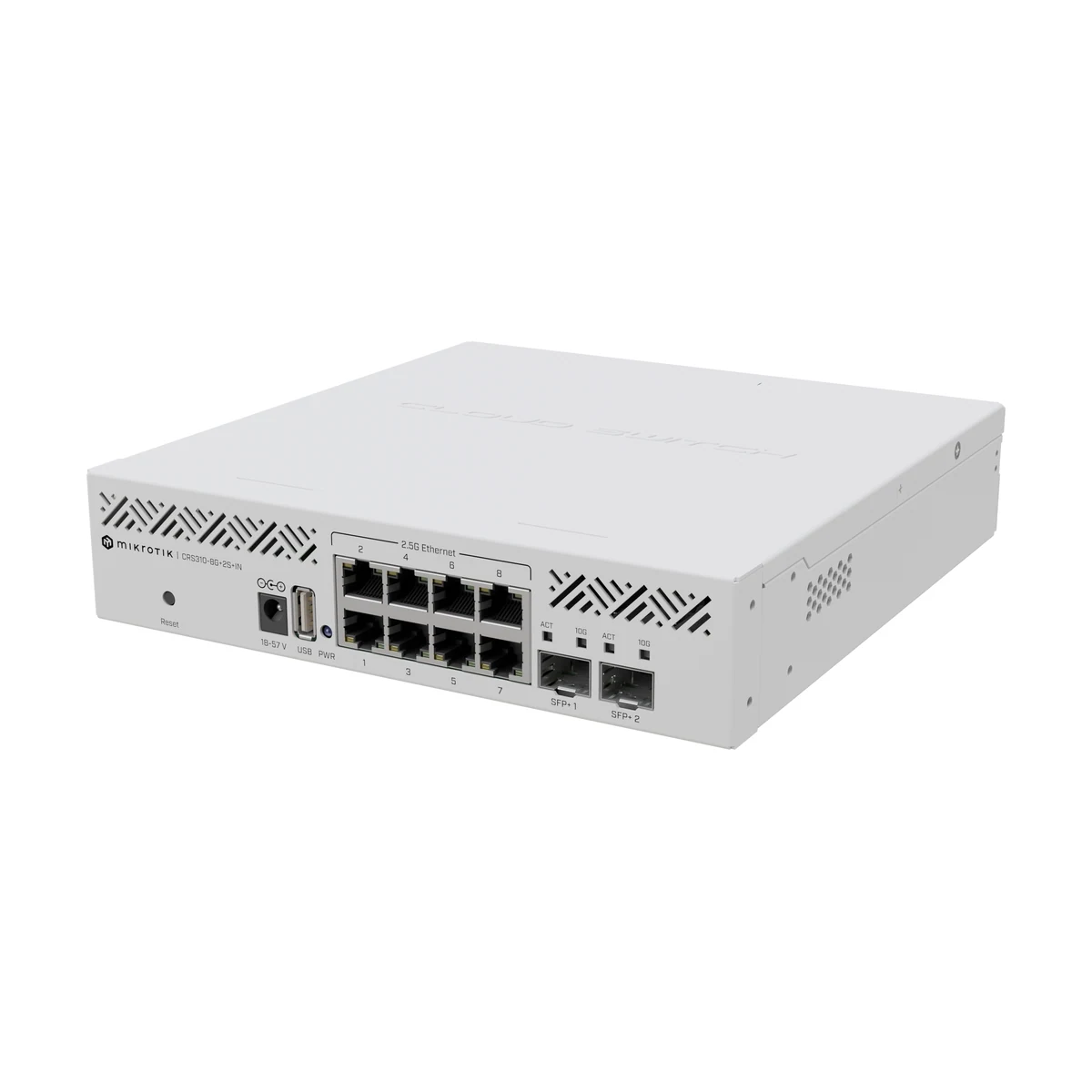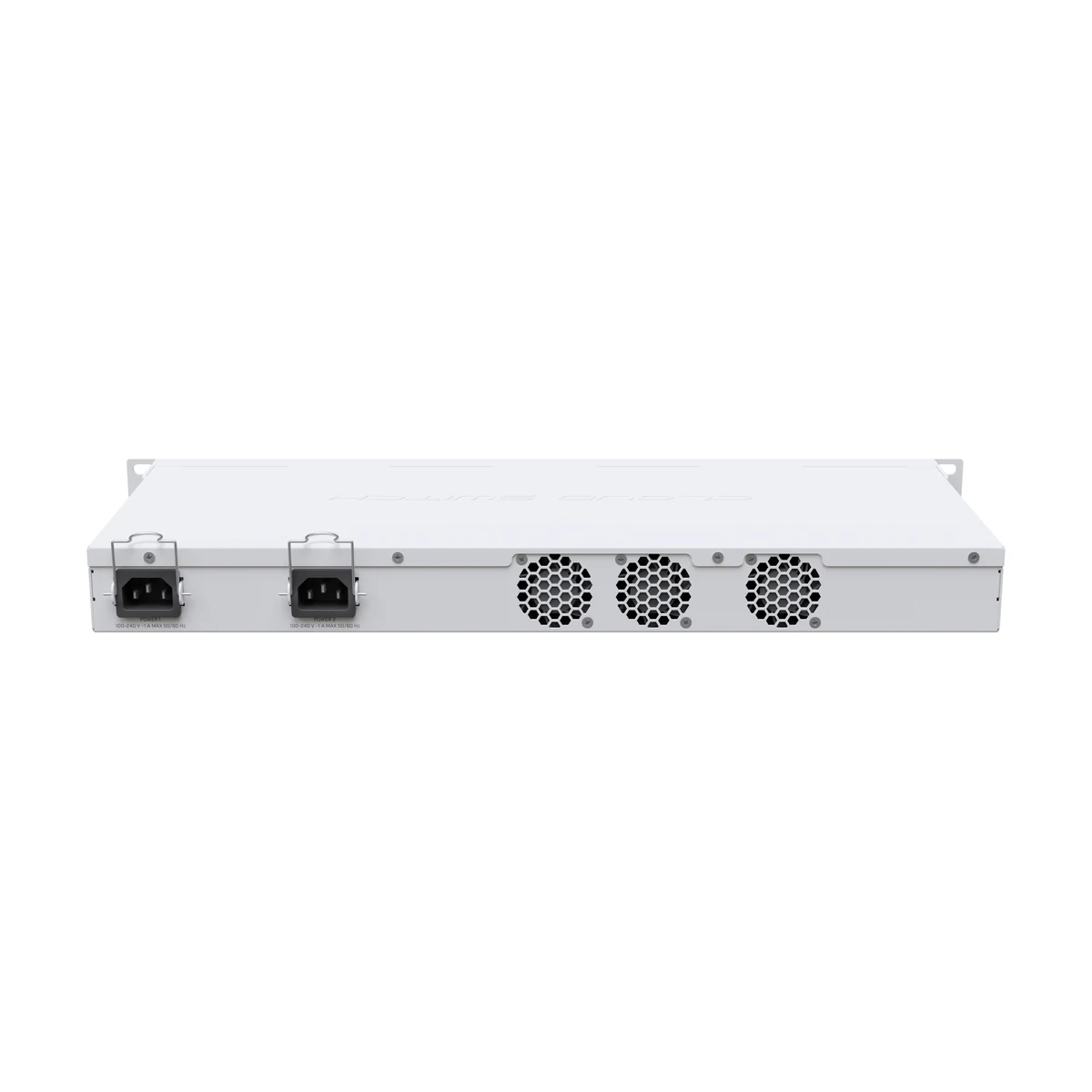
MikroTik CRS326-24S+2Q+RM
MikroTik CRS326-24S+2Q+RM — fast switch for demanding networks: 24× SFP+ and 2× QSFP+, 1U rack.
- PoE
- No
- SFP+ ports
- 24
- QSFP+ ports
- 2
- Speed
- 40 Gbps
- Management
- Managed (RouterOS)
- Form factor
- Rack-mount
The MikroTik CRS326-24S+2Q+RM is a 1U rack-mount aggregation switch: twenty-four SFP+ ports at 10 Gbps and two QSFP+ ports at 40 Gbps. There are no copper data ports — the device is built for fully optical nodes: server racks, a building network core, carrier sites. Switching is done in hardware, so performance does not depend on CPU load. Management is SwOS or RouterOS, at the engineer's choice.
Twenty-four ten-gigabit ports cover the connection of servers, storage systems and lines to floor access switches. The two 40 Gbps QSFP+ ports serve as uplinks to the core or a neighboring rack, so the backbone never becomes a bottleneck under full load. The non-blocking fabric lets all ports run at full speed simultaneously: the node aggregates camera streams, server traffic and building backbones in a single unit, leaving headroom for growth.
Advantages
- 24 SFP+ 10 Gbps ports in a single 1U unit
- Two QSFP+ 40 Gbps uplinks to the core or storage
- Non-blocking fabric — full speed on all ports
- Hardware switching with no CPU load
- Choice of management system: SwOS or RouterOS
- Rack-mount design for tidy installation in a 19-inch cabinet
Applications
- Aggregation of 10G lines of a building or campus
- Server racks and mini data centers
- Core of a large video surveillance network
- Carrier and ISP nodes
Installation and setup
The switch is mounted in a 19-inch rack with attention to airflow and convenient routing of fiber runs. SFP+ and QSFP+ modules are selected separately for fiber type and distance; inside the rack, servers are economically connected with DAC cables, between floors — with fiber. A typical layout: floor access switches converge into the SFP+ ports while the 40G uplink goes to the core router. Plain L2 aggregation needs only SwOS; for VLAN segmentation and routing, RouterOS is the choice. Supplied from our warehouse in Tashkent — we can help select modules and draw up the node specification.
Frequently asked questions
What tasks call for 24 SFP+ ports?
What do the two 40G QSFP+ ports give?
Can it handle the load at full speed?
Which to choose — SwOS or RouterOS?
Product reviews
Questions & answers