Service
Body cameras for staff in Tashkent — supply and rollout
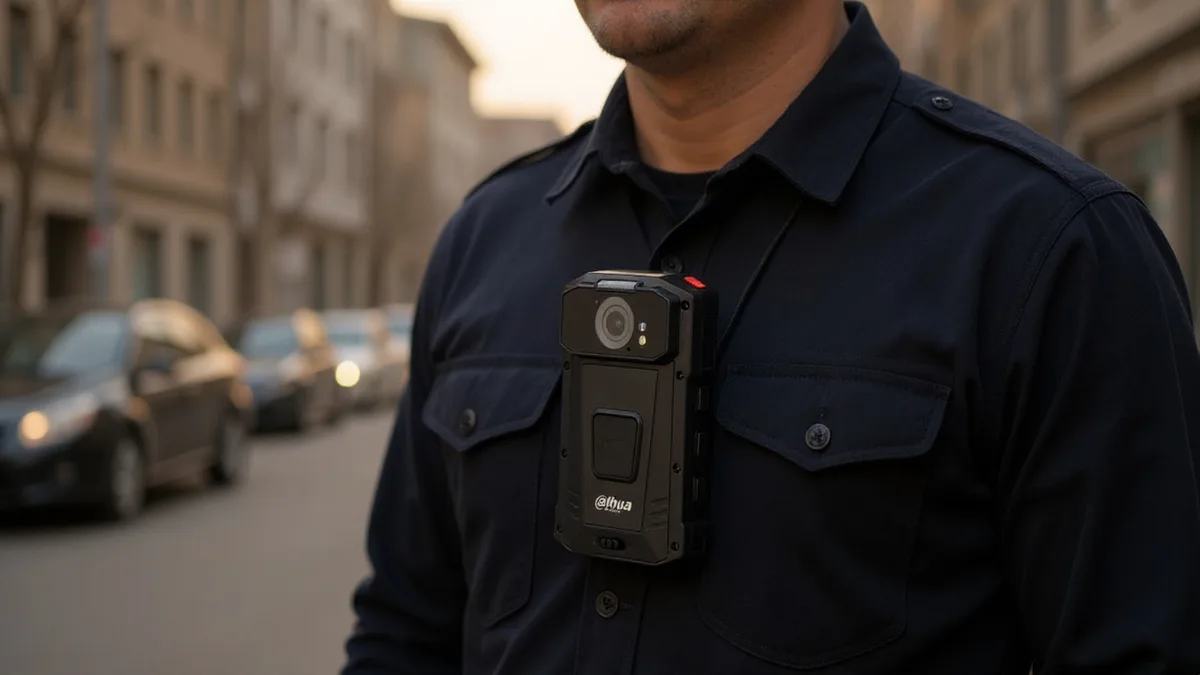
We supply and roll out body cameras for staff on duty: inspectors, parking enforcement officers, security guards, couriers, cash-in-transit crews. The camera openly records the whole shift — oversight of the work and protection for the employee against unfounded complaints. Docking stations that upload recordings automatically, an archive on your own server and dispatcher software: 350 Dahua cameras are already in service with our clients.
What's included
Scope of work
- Camera selection for the task: resolution, full-shift battery, 4G, GPS, IP67/IP68 protection
- Sizing docking stations and storage to your headcount and shifts
- Installing docks, server and video archive inside Uzbekistan
- Software setup: live view, map, group talk, archive search, access rights
- Usage policy, staff training and warranty service
Body cameras for business: how the system works and what it includes
A body camera — also called a bodycam, body-worn camera or wearable camera — is a personal video recorder that clips to an employee's chest and records the working shift with sound. It belongs wherever work happens on the street and in front of customers rather than in an office: parking enforcement, inspectors, security, couriers, cash collection, field service. The recording ends word-against-word disputes, keeps both sides of the conversation polite and provides evidence if a situation ever reaches a formal review.
The camera itself is only a third of the system. The second third is the docking station: at the end of the shift the employee drops the camera into it, and the station charges it while uploading every recording to the central archive. One station takes up to 8 cameras, so 100 cameras returned at the end of one shift need 13 stations: 100 ÷ 8, rounded up. Without docks, footage has to be pulled over a cable by hand, and in practice some files get lost or never uploaded at all.
The final third is software. The Dahua DSS Pro platform, or the video management system you already run, shows the dispatcher the status, charge and upload progress of every camera and searches recordings by date, employee and area. 4G cameras add live video, the officer's position on a map, an SOS button and push-to-talk group voice — the camera doubles as a radio.
We choose a camera on five criteria. Resolution: Full HD is enough for faces at conversation distance, 2K reads licence plates and documents. Battery: the camera must last the whole shift — the DH-MPT230 with its external battery manages up to 10 hours. IP67–IP68 protection for rain and dust. IR illumination up to 10 m for shifts after dark. GPS and 4G if the dispatcher needs to see people on a map in real time.
Video showing identifiable people is personal data. Uzbekistan's personal data law (ZRU-547) requires citizens' data to be stored on servers inside the country, so we deploy the archive on your server or on storage located in Uzbekistan. Along with the system we hand over a policy template: who wears a camera, when recording is mandatory, how long the archive is kept and who may access it; staff sign to confirm they have read it, and customers are informed by a "video recording in progress" badge.
Rollout takes three steps. A pilot of 10–15 cameras on one site, where the policy, shifts and docks are tested in real work. Then sizing of the full fleet and storage from the pilot data — how many hours one camera actually records per day and how many days the archive must be kept. Only then the rollout to the whole team, with training for staff and dispatchers.
Our experience is hands-on. For the city parking operator StreetParking we supplied 150 Dahua DH-MPT230 cameras with DH-EEC300D8-N1 docking stations and the DSS Pro platform: officers take a charged camera at the start of a shift, return it to the dock at the end, and the archive builds itself. For a state inspectorate — 200 DH-MPT230 cameras and 15 DH-EEC400-D docking stations connected to the client's existing server: live video, face and plate recognition, group talk. For smaller teams our catalogue offers the Hikvision DS-MCW406 body camera with 64 GB memory, GPS and Wi-Fi.
Equipment we install

Examples
Completed projects

SAT Solutions
Solutions by industry
Examples
Gallery
How we work
SAT Solutions terms of work
Installation work is covered for 3 years; equipment for 1 to 3 years per the manufacturer. Warranty visits within one business day.
3 engineers and 15 installers on staff, no subcontractors. We work in Tashkent and across Uzbekistan.
Site visits in Tashkent are free and happen on the day you call. Regions by arrangement.
After the survey we prepare an estimate and a commercial proposal within one business day. No obligation.
Contract with a legal entity, invoice, VAT-compliant billing, acceptance acts and as-built documentation. We also work with private clients.
Security systems installation — National Guard of Uzbekistan licence No. 1554491. Fire alarm and evacuation systems — Ministry of Emergency Situations licence No. 913518. View licences
Questions & answers
Frequently asked questions
Are a body camera, body-worn camera and wearable camera the same thing?
How long does a body camera run on one charge?
Why a docking station if footage can be copied over USB?
Can we watch the camera feed live?
Where is the archive stored, and is it legal?
How much does a body camera rollout cost?
Useful articles
Start a project
Need body cameras for staff?
We'll select equipment for your site and send a quote within one business day.