Service
Smart Parking Management in Tashkent
Intelligent parking management: license plate recognition, bay occupancy sensors, guidance displays and automated payment — for malls, business centers and residential complexes.
What's included
Scope of work
- Survey and parking design
- Barriers and ANPR cameras
- Bay sensors and guidance displays
- Pay stations, tariffs and payment integration
- Commissioning, warranty, service
Smart Parking Equipment: Barriers, ANPR and Space Sensors
A parking system is assembled from lanes: an entry lane, an exit lane, sometimes a reversible one. One lane consists of a barrier, a plate recognition camera, a vehicle presence detector, a traffic light or light indication, a terminal pedestal and an intercom to the operator. All of it comes together at the lane controller, and the controllers at the parking server. One lane running on plate recognition passes 350-500 vehicles per hour, and about half that when tickets are issued: the bottleneck is not the barrier drive but the driver's reaction time.
A barrier is chosen by the width of the passage and the traffic intensity, not by price. Up to three metres and under 300 cycles a day a light-duty series is enough; the entrance to a shopping centre needs a drive rated at 100% duty with an opening time of 1.5-3 seconds. The catalogue covers this with Dahua and ZKTeco BGM and CMP series and with KANIHAD KND-BGM350. Booms come straight, telescopic for low ceilings, and fenced where walking around must be prevented. Safety photocells and a detector under the boom are mandatory: without them the drive will sooner or later lower the boom onto a car roof.
The plate recognition rate is set by installation geometry, not by the camera's price tag. The horizontal angle between the lens axis and the plate plane must stay within 30 degrees, and so must the vertical one; the working distance is 3-7 metres and the character height in frame no less than 25-30 pixels. A short exposure and the camera's own infrared illuminator are required, otherwise headlights turn the plate into a white patch at night. With those conditions met, a dedicated camera — Hikvision, Dahua or ZKTeco E-LPRC500 — reliably reads 95-98% of clean Uzbek-standard plates. Dirt, ice, decorative frames and non-standard fonts lower the result, so a fallback is always designed in: a ticket, a card or manual opening by the operator.
The presence of a vehicle under the boom is detected by an inductive loop or by radar. A loop is a coil of cable in a saw cut 40-50 mm deep: cheap and accurate, but it requires opening the surface and suffers from cracks and ground movement. A radar detector such as the VR10 Pro mounts on the barrier post, goes in within an hour and is indifferent to the surface, which is why it is chosen on finished yards and on block paving. The detector does two jobs: it issues the close command as soon as the car has passed, and it forbids closing while the car is still under the boom.
A ticket layer is needed wherever time is billed. A ticket dispenser of the TBM01 class prints a coupon with a barcode or QR, an automatic pay station takes cash and cards, and a manned desk at the exit clears the coupon. The tariff grid lives in the server configuration: the billing step, the free first minutes, the daily cap, different rates by zone and vehicle type, season passes tied to a plate with an entry limit, validation by a tenant's receipt. All of it changes in the interface without reworking hardware — a property worth designing in from the start, because tariffs on a site are revised far more often than the hardware.
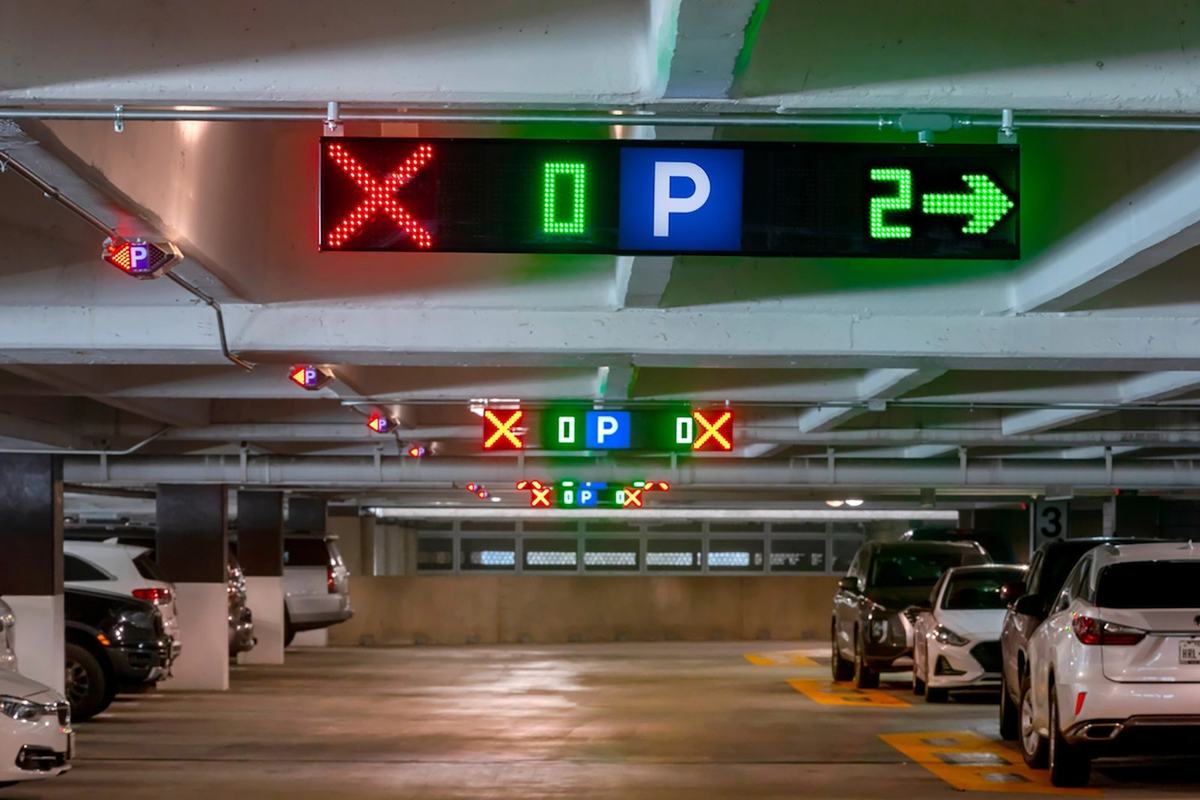
Space occupancy is counted in two ways. An ultrasonic sensor above every bay with a two-colour indicator gives accuracy down to the individual space and a colour cue along the aisle, but it needs a ceiling and costs more per space, so it belongs in enclosed garages. Video analytics on a camera covering four to six bays is cheaper per space and keeps an archive on the side, but it is sensitive to backlight and a dirty lens. The result goes to LED displays: a total at the entrance, per floor on the ramps, per sector at the junctions. The zone counters are kept by the server, so the displays and the mobile app always show the same figure.
The server side is an industrial computer in a rack, a database holding the passage log and the snapshots, and licences for lanes and operator workstations. Hardware demands are modest, but disk volume is critical: one snapshot per passage at 2000 vehicles a day comes to roughly 200-300 GB a year, and the retention depth is fixed at the design stage. Integrations are built over an API and over dry contacts: an access controller accepts a plate as an identifier on par with a card, the recorder receives an event marker and returns the fragment on a click in the log, and shift and payment exports go to the accounting software as a file or a query. If access control and CCTV are already running on site, replacing them is usually unnecessary — a gateway is enough.
The site has to be prepared, and better before installation: 220 V with a dedicated breaker per lane and a UPS for the controllers and the server, routes in conduit or tray from the lane to the server room, cast-in fixings for the pedestals on a concrete base, at least 50 lux at the entry zone and reliable network coverage for the terminals. Outdoor equipment is installed to IP54 or better, and drives in unheated areas come with heaters. Operation comes down to seasonal checks: in spring we clean and realign the recognition cameras and ring out the loops after the frosts, in autumn we check pedestal sealing, heating and UPS battery capacity, and twice a year we rebalance the boom and test the photocells. We service what we installed and equipment of our own supply; we work on weekdays from 9:00 to 18:00 and answer an enquiry within the working day.
Typical solutions
Three levels of smart parking
Every site is priced individually: describe the task or send a plan — we will return a quote with an exact estimate within one business day.
Automatic entry
Courtyard, office lot
- A barrier + plate recognition
- A whitelist with no remotes
- Guest passes from the app
- An entry log with photos
Time: 2–4 days
Paid parking
Mall, hotel, city lot
- Entry/exit terminals, tickets or QR
- Pay stations and terminals
- Tariffs: hours, passes, discounts
- A free-space display
Time: 2–4 weeks
A multi-level garage
Business center, airport, residential complex
- Occupancy sensors above the spaces
- Navigation to a free space
- Find-my-car by plate
- Integration with ANPR and access control
Time: per design
How we work
From entry geometry to working lanes — 5 steps
Measurements
radii, slopes, the plate-reading point
Lane design
cameras, barriers, loops, lights
Installation
the lane as a whole, tested on cars
Scenarios
resident, guest, delivery, tariffs
Launch
recognition monitoring in the first weeks
Equipment
ANPR and automation that never sleep
Hikvision/Dahua recognition cameras, heavy-duty barriers, terminals and pay stations — from stock:
This system connects to the resident app: entrance and barrier from a phone, guests by QR code, requests to the management company and the monthly bill.
See SAT UyEquipment we install


Examples
Completed projects
SAT Solutions
Solutions by industry
Examples
Gallery
Questions & answers
Frequently asked questions
What does plate recognition (ANPR) give?
How do bay occupancy sensors work?
Can payment be automated?
Start a project
Need smart parking?
We'll select equipment for your site and send a quote within one business day.