Service
Fiber Optic Cabling in Tashkent
We lay and splice fiber optics: backbones between buildings, floors and shops, outdoor routes on poles and facades, fusion splicing and OTDR measurements with reports.
What's included
Scope of work
- Route design and cable selection (indoor, outdoor, ADSS)
- Laying in cable ducts, on poles and facades
- Fusion splicing and optical cross installation
- OTDR measurements and line reports
- Restoring damaged lines on routes we laid ourselves
Fiber Optic Installation and Splicing in Tashkent
Fiber optic lines are the only way to move data fast and reliably over distance: between buildings, workshops, floors and remote sites. SAT Solutions designs, lays and splices fiber for enterprises, campuses, data centers, residential complexes and telecom operators — from a short link between two buildings to backbones running tens of kilometers.
Copper ends at a hundred meters — beyond that, fiber begins. It does not fear lightning or ground potential differences between buildings, which burn out the ports of copper links; it picks up no interference from power cables and runs at 10G and beyond without reservations. That is why inter-building links, far-perimeter outdoor cameras and backbones inside large buildings are always designed in fiber — cheaper than replacing burnt switches every season.
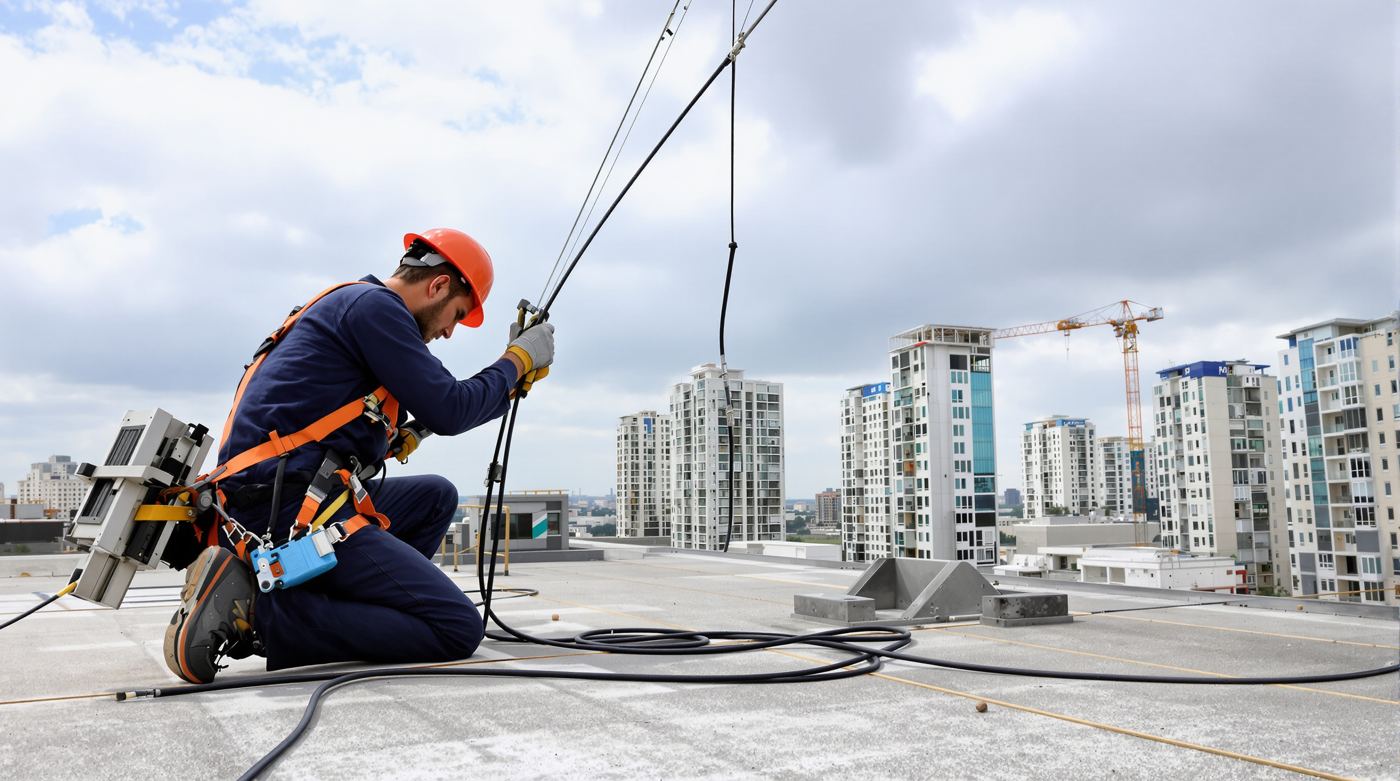
The route dictates the installation method. In the ground, cable runs in protective HDPE duct with rodent armor; in cable ducting, with a draw rope; overhead between poles and buildings, self-supporting cable with a messenger rated for wind and icing; indoors, flame-retardant cable in trays and risers. We also choose the fiber itself: single-mode for distance and backbones, multimode for short runs inside a server room.
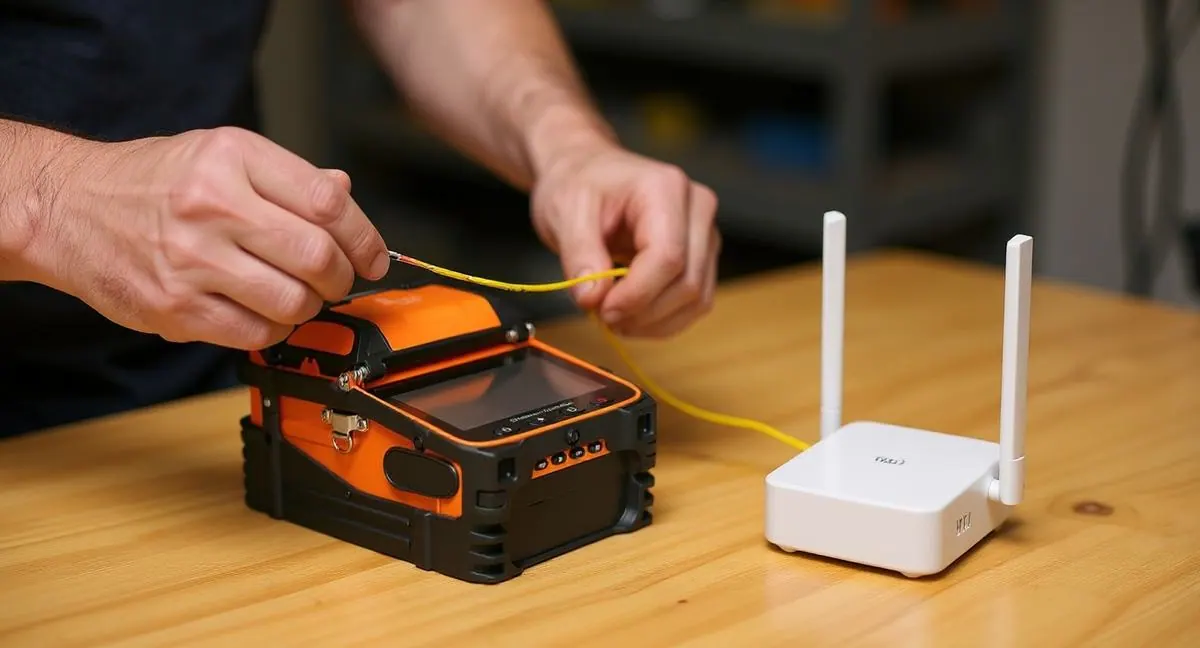
Splicing is the jeweler's part of the job. The splicer aligns fibers by the core and fuses them with losses in hundredths of a decibel; every splice is protected with a sleeve and laid into a closure or a patch panel. A bad splice is invisible to the eye, but it eats the link budget — and shows up as lost speed and outages at the worst moment. Our splicers work on professional auto-alignment machines.
Every link is handed over with measurements, not by eye. An OTDR trace shows the whole route: length, attenuation, every splice and connector, microcracks and bends. The customer receives a test report per fiber — a document that ends disputes with any future contractor and pinpoints the damage location if the cable is cut during excavation.
Fiber also means the active layer around it. We select and configure SFP modules for the distance and speed, media converters, and PON equipment for distributed networks: one fiber branches through splitters to dozens of buildings or apartments with no active gear along the route. For operators and ISPs we build the last mile and subscriber distribution.
Emergency response is a separate service: a cable cut by an excavator is localised by OTDR to the meter and restored with a closure the same day. The price depends on length, installation method, fiber count and splices; after a free site visit you get a full quote. Warranty on links and splices, service by contract — Tashkent and all of Uzbekistan.
Standard solutions
Three standard fiber jobs
We price by the route: send the distance and what lies between the points — buildings, a road, poles — and we return a quote with an exact estimate within one business day.
Link between buildings
Two blocks, office and warehouse, shop floor and admin building
- Route along poles, the façade or through cable ducts
- Outdoor or ADSS cable — depending on site conditions
- Fibers spliced, optical patch panels fitted at both ends
- OTDR test report handed over on completion
Timeline: 1–3 days
Backbone inside a building
Multi-story office, residential complex, shopping center
- Riser between floors, a patch panel on every floor
- Spare fibers for future expansion
- Labelling and a line diagram in the documentation
- Route agreed against fire safety requirements
Timeline: by project, from 1 week
Repair of a damaged line
A break after excavation work or an accident
- We locate the break with an OTDR
- Splicing on site and fitting of a closure
- Verification measurements after the repair
- Report with attenuation for every fiber
Timeline: we come out the same day
How we work
From request to a line with a test report — 5 steps
Engineer visit
we walk the route, check distance and installation method — free of charge
Design and quote
cable type, fiber count, patch panels, itemised estimate — within one business day
Laying
along poles, the façade or through ducts, with fixings and slack
Splicing and testing
fibers spliced, panels fitted, OTDR trace on every fiber
Handover
test report and line diagram; warranty on the work
Materials
Cable and optical patch panels
Indoor, outdoor and ADSS cable, patch panels, closures and pigtails — chosen for the route and supplied by us.
How it works
How the system works
Related services
You may also need
Structured cabling & LAN
Structured cabling, Wi-Fi and IT infrastructure.
Wi-Fi Networks
Seamless coverage for offices, warehouses and outdoor areas — no dead zones.
Wireless Bridges
Internet and network between buildings without cable — up to 20+ km.
MikroTik Setup
Routers, VLAN, dual WAN, VPN and Wi-Fi — configuration and audit.
Equipment we install




How we work
SAT Solutions terms of work
Installation work is covered for 3 years; equipment for 1 to 3 years per the manufacturer. Warranty visits within one business day.
3 engineers and 15 installers on staff, no subcontractors. We work in Tashkent and across Uzbekistan.
Site visits in Tashkent are free and happen on the day you call. Regions by arrangement.
After the survey we prepare an estimate and a commercial proposal within one business day. No obligation.
Contract with a legal entity, invoice, VAT-compliant billing, acceptance acts and as-built documentation. We also work with private clients.
Security systems installation — National Guard of Uzbekistan licence No. 1554491. Fire alarm and evacuation systems — Ministry of Emergency Situations licence No. 913518. View licences
Questions & answers
Frequently asked questions
When do you need fiber optics instead of twisted pair?
What distance can fiber optic cable cover?
Do you provide fiber splicing services with on-site visits?
Do you repair fiber optic breaks?
How much does fiber optic installation cost?
Useful articles
Start a project
Need fiber optic lines?
We'll select equipment for your site and send a quote within one business day.