Service
Fire Alarm System Design & Installation in Uzbekistan
Automatic fire alarms and evacuation warning and control systems — designed and installed to standards with the required licenses.
What's included
Scope of work
- Fire alarm and evacuation system design to standards
- Installation of detectors, panels and sounders
- Configuring zones and evacuation scenarios
- Handover to supervisory authorities
- Scheduled maintenance
Fire Alarm and Voice Evacuation Installation in Tashkent
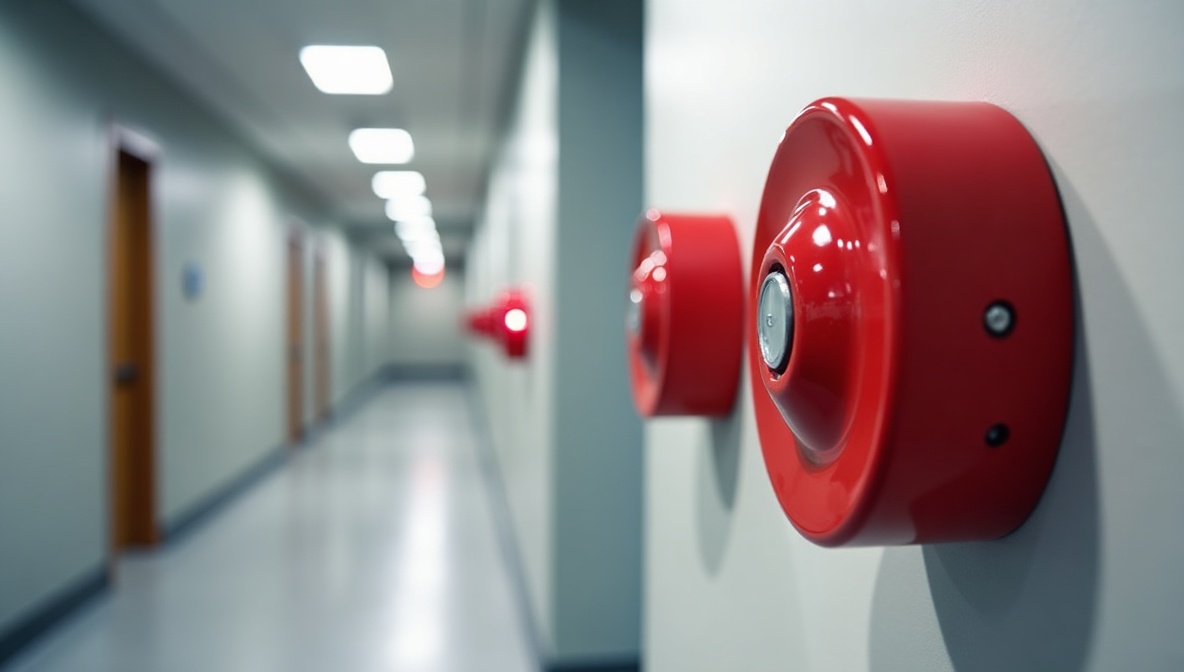
An automatic fire alarm detects a fire at an early stage by smoke, heat or flame and triggers the voice evacuation system. SAT Solutions designs, supplies and installs fire alarms for offices, shops, warehouses, factories and public buildings in accordance with Uzbekistan's fire safety codes.
A system includes fire detectors (smoke, heat, manual call points), control panels, sounders and beacons, and where required — automation controlling smoke extraction, suppression and the building's engineering systems. What the system must contain is set by the building's use, area and number of storeys rather than by the client's wishes — and that is the first thing the review checks.
Fire alarm maintenance in Uzbekistan is governed by Cabinet of Ministers Resolution No. 649 of 20 October 2020. Clause 148 requires servicing and preventive repair to follow an annual plan based on the manufacturer's documentation — there is no fixed "once a quarter" rule in the country; the schedule is derived from the actual equipment. Clause 149 is stricter: a contract with a licensed organisation must be signed within thirty days of the system being commissioned, and if that contract is terminated the Ministry of Emergency Situations must be notified within twenty-four hours. We hold such a contract on the systems we installed and keep the logbook in a state that leaves an inspector nothing to ask about.
An alarm detects a fire; extinguishing it is the job of an automatic suppression system — a separate system usually designed together with the alarm. Gas suppression is used where water and powder would destroy the assets: server rooms, data centers, archives, switchrooms — the agent displaces oxygen and leaves no trace on equipment. Powder modules are cheaper and suit warehouses, garages, production and utility rooms. Water and sprinkler systems cover large areas where containing the fire matters more than preserving equipment.
In fire safety, the design and the documents mean as much as the installation. We design fire alarms to Uzbekistan's codes, get the design approved, install, commission and hand the site over to the authorities with as-built documentation. For operating sites we run surveys: it often turns out detectors violate coverage zones, loops are overloaded, and the panel has gone years without scheduled maintenance.
The cost is built from the area and purpose of the rooms, the number of detectors and loops, the panel type, and the need for voice evacuation and smoke extraction control. The price for an office differs fundamentally from a high-bay warehouse — the detector mounting height and type both change. After handover we take the system onto scheduled maintenance: detector checks, battery replacement, reports — without it, inspectors will fault even a working system.
Voice evacuation systems differ by type — from a simple siren to zoned voice announcements with evacuation flow control. A small office is fine with sounders and exit signs; a shopping mall, hotel or plant with hundreds of people needs voice notification: pre-recorded zone messages reduce panic and split the flows onto different stairways. The system type is set by the building's purpose and capacity under the codes — we put it into the design and back it with calculations, so the question never surfaces at handover.
A fire alarm shows its worth in concert with the building's other systems. On alarm, the access-control evacuation doors release, general ventilation shuts down, elevators descend to the ground floor, and the signal goes to the guard post and the phones of those responsible. We write these scenarios into the design and verify them at commissioning loop by loop — because in a real fire there will be no time left to check.
Typical solutions
Fire alarm for three types of sites
System composition is dictated by fire safety codes — after a free survey we will state exactly what your site needs and price it.
Shop, office, café
Premises up to ~300 m², rented format
- Conventional alarm: smoke and heat detectors, sounder
- Rubezh or Altai panels — affordable and certified
- EXIT signs, manual call points at exits
- The site passes fire inspection
Time: 1–3 days
Office building, school, clinic
Multi-floor building with permanent staff
- Bolid or Rubezh addressable system — the panel sees every detector
- Evacuation alerting: sounders, signs, escape route lights
- Status output to the security desk
- Design by licensed specialists + as-built documents
Time: 1–3 weeks
Warehouse, production, mall
Large areas, high ceilings, complex codes
- Analogue addressable system: beam and aspirating detectors
- Voice evacuation: Rupor, zoned announcements
- Smoke extraction and suppression control
- Design, approvals, inspection handover — on us
Time: per project, from 1 month
How we work
From audit to inspection handover — 5 steps
Survey
site and code requirements audit — free
Design
alarm and evacuation sections, specification, licenses
Installation
detectors, loops, sounders — per design
Commissioning
every detector tested, inspection handover
Maintenance
scheduled service — the system always ready
Equipment
Panels and detectors — from our Tashkent warehouse
Bolid and Rubezh — certified equipment with warranty, panels and detectors always in stock:
How it works
How the system works
Equipment we install


Examples
Completed projects


SAT Solutions
Solutions by industry
Examples
Gallery
Questions & answers
Frequently asked questions
Is fire alarm system mandatory?
What equipment do you use?
Do you handle design and commissioning?
Is maintenance required?
Useful articles
Start a project
Need fire alarm & evacuation?
We'll select equipment for your site and send a quote within one business day.