In short
- In a radio addressable system, battery detectors connect to the addressable loop by radio through a radio expander and appear to the panel as ordinary addressable devices.
- The link is two-way and supervised; range is extended with repeaters — up to 10 repeating levels in Rubezh R3 according to the manufacturer.
- New in 2025–2026: Rubezh R3 with up to 4,000 devices per system and detectors lasting up to 10 years on batteries; Bolid S2000R-ARR125 for 125 devices.
- Radio wins on finished sites, in operating buildings and for remote rooms; cable wins in new construction and on large uniform areas.
- Wire and radio combine on one addressable loop; Rubezh R3 and Bolid S2000R radio equipment is supplied to order.
An addressable system and where radio fits in
An addressable fire alarm works like this: a control panel runs an addressable loop on which every detector has its own number. When triggered, the panel shows not “zone in alarm” but the exact room and device, monitors chamber contamination and reports faults by itself. We covered the difference between conventional, addressable and analogue addressable systems in our article on fire alarm types.
In a radio system some detectors are connected to the same addressable loop not by wire but by radio — through a radio expander. To the panel they look like ordinary addressable devices: each has a number, a status and a log. Only the way the signal travels from the detector to the loop changes.
Fire Alarm and Fire Suppression Installation in Uzbekistan →
How the radio link works
At the heart of the radio part is a radio expander installed on the addressable loop that keeps in touch with the radio devices around it. At Bolid this is the S2000R-ARR125: according to the manufacturer it connects up to 125 S2000R radio devices to the S2000-KDL loop controller and constantly supervises the link with each. In Rubezh R3 the role is played by the RRS-250-R3 — a loop expander or repeater.
Detectors run on batteries. The link is two-way and supervised: if a detector is removed, fails or its battery runs low, the panel registers a fault just as it would a broken wire in a wired system. Where the signal does not reach, repeaters are added: for Rubezh R3 the manufacturer states up to 10 levels of repeating and a range of up to 1,000 metres in open space, and Bolid’s S2000-RPI ver.02 radio repeater is rated for at least 1,200 metres in open terrain.
What is new in 2025–2026
In 2025 Rubezh showed its R3 radio system for residential buildings with complex layouts: according to the manufacturer, up to 250 radio devices per addressable loop, up to 500 per panel and up to 4,000 per system, at 868 MHz. In 2026 a new radio solution was introduced within R3 with automatic network building and detector service life of up to 10 years on one set of batteries; the new devices are supported in FireSec NT software.
Bolid updated its S2000R radio line: the S2000R-ARR125 radio expander for 125 devices replaced the previous 32-device model, and the S2000-RPI ver.02 radio repeater and the S2000R-OST radio “Exit” sign were added. For the owner this means radio systems now hold more devices and batteries need changing less often.
When radio beats cable
Radio pays off where cable is expensive or impossible to run. A finished interior with costly finishes, stretch or suspended ceilings of complex shape, marble and wood — chasing walls and restoring the finish costs more than the price gap between detectors. Historic buildings and museums where work on the walls is restricted. Operating hotels, offices and shops: a radio system goes in faster and with almost no dust, and the site keeps working.
The second scenario is remote rooms and extensions. A warehouse across the yard, an annex, a second building: a radio repeater instead of a trench or an overhead run. If a few rooms must be added to an existing addressable system after a re-layout, a radio expander on the same loop solves it without new cable runs.
When cable is more reliable and cheaper
During construction and major refurbishment cable almost always wins: a wired addressable detector costs less than a radio one, and the route is laid together with the other services anyway. Wired detectors need no batteries, so maintenance has no scheduled battery replacement. For example, the wired analogue addressable Bolid DIP-34A-03 smoke detector costs 218,900 UZS in our catalogue.
Radio is sensitive to its environment: steel structures, reinforced concrete, metal racking and strong sources of interference weaken the signal. That is why a radio survey of the site is carried out before a radio system — to check where the signal is stable and where repeaters are needed. On large uniform areas such as warehouses and workshops, a wired system usually turns out simpler and cheaper.
Hybrid: wire and radio in one system
You do not have to choose one or the other. A radio expander sits on the same addressable loop as the wired detectors, so the main building can be cabled while the finished lobby, meeting rooms and annex go on radio. The panel, event log, monitoring and voice alarm remain shared.
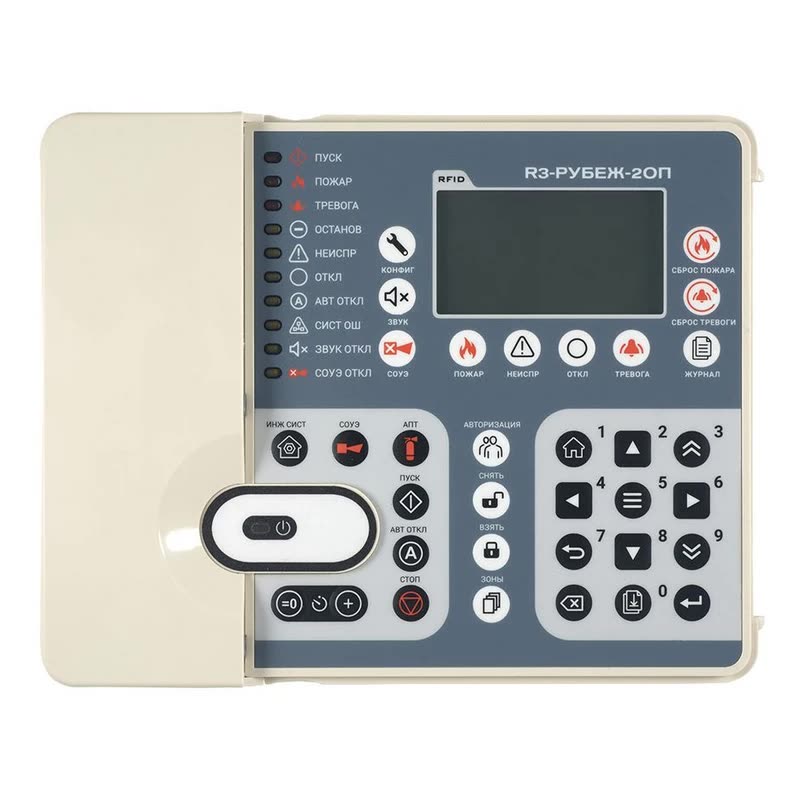
An example with equipment from our catalogue: the Bolid S2000-KDL loop controller for 127 addressable devices (1,026,900 UZS) serves wired DIP-34A detectors and an S2000R-ARR125 radio expander for the radio devices. For a Rubezh system the core is the R3-Rubezh-2OP panel with two addressable loops of up to 250 devices each (8,942,900 UZS), with an RRS-250-R3 radio expander connected to the loop.
What to plan in advance
Batteries. The panel warns in advance when any radio detector’s battery runs low, but replacement belongs in the annual maintenance plan — just like checking smoke chambers and testing the voice alarm. Battery life depends on the model and conditions; for new Rubezh R3 devices the manufacturer states up to 10 years. Fire alarm maintenance under Uzbek requirements is covered in a separate article of ours.
Documentation. The radio decision is written into the system design in line with ShNK 2.04.09-2007 and the conditions of the specific site, and the as-built documentation covers both wired and radio devices. Equipment must be certified, and installation is carried out by an organisation holding the permits for this type of work.
What it costs and how to order
A radio detector costs more than a wired one, but on finished sites the savings on cable runs and wall restoration cover the difference. Catalogue prices on 2 November 2026: the Bolid S2000R-OST ver.01 radio “Exit” sign — 679,900 UZS, the S2000-KDL loop controller — 1,026,900 UZS, the wired DIP-34A-03 smoke detector — 218,900 UZS, the R3-Rubezh-2OP panel — 8,942,900 UZS. Rubezh R3 and Bolid S2000R radio detectors and expanders are supplied to order for the specific site.
We survey the site and price a cabled, a radio and a hybrid option so you can see where radio really saves money, then install, commission and hand over the system with documentation. Our work carries a 3-year warranty. A calculation can be ordered on our fire alarm page — we return a quote within one business day.
Product from this article
- Bolid S2000R-OST ver.01 radio “Exit” light signPrice and specifications in the catalog →
- Bolid S2000-KDL addressable loop controller (up to 127 devices)Price and specifications in the catalog →
- Rubezh R3-Rubezh-2OP addressable panel (2 loops of 250 devices)Price and specifications in the catalog →
- Bolid DIP-34A-03 wired analogue addressable smoke detectorPrice and specifications in the catalog →
FAQ
Is a wireless fire alarm reliable?
Addressable radio systems use a two-way, supervised link: if a detector drops off the network or its battery runs low, the panel registers a fault. Reliability comes from a radio survey of the site and repeaters where the signal is weak.
How often do radio detector batteries need changing?
It depends on the model and conditions; the panel warns in advance about each detector’s battery. For new Rubezh R3 devices the manufacturer states up to 10 years on one set. Replacement goes into the annual maintenance plan.
Can radio detectors be added to an existing wired system?
Yes, if the system supports radio expanders: at Bolid this is the S2000R-ARR125 on the S2000-KDL loop, at Rubezh R3 the RRS-250-R3. Radio devices join the same addressable loop.
Is a radio system more expensive than a wired one?
The equipment costs more, but on finished sites the savings on cable runs and wall restoration often cover the difference. In new construction a wired system is usually cheaper.
What interferes with the radio signal?
Steel structures, reinforced concrete, metal racking and strong interference sources. That is why a radio survey is done before installation and repeaters are added where needed.
Do you supply radio fire alarm equipment?
Yes, Rubezh R3 and Bolid S2000R radio detectors and expanders are supplied to order for the specific site, together with installation and commissioning.
Installation works cost calculator
Set the number of points — the calculator shows the price range from our standard price list. One minute, no phone calls.
Read also


Related services
Catalog on the topic