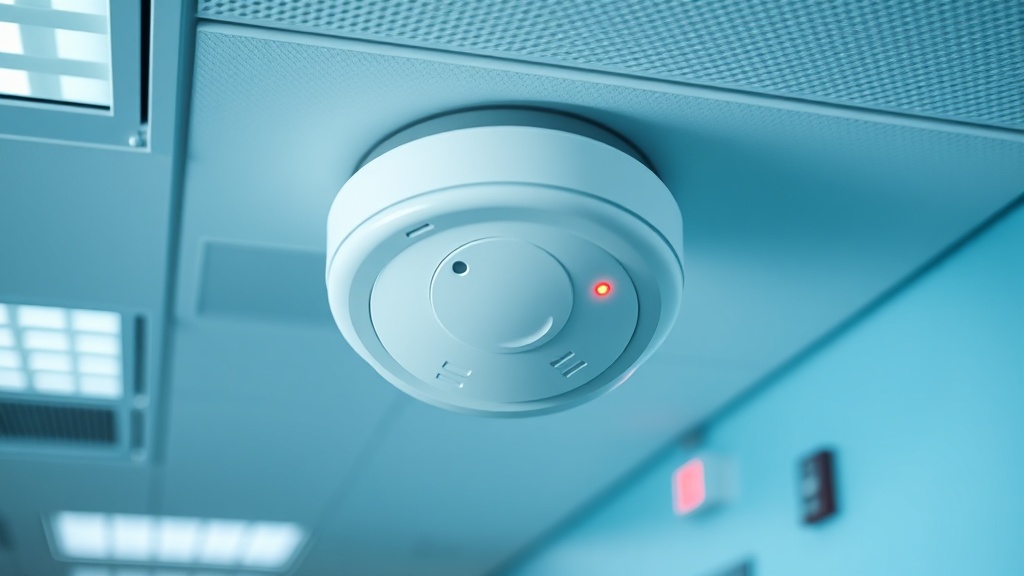
Three system types — the difference
A conventional (non-addressable) alarm is the simplest and cheapest: detectors are grouped into loops, and on activation the panel shows only the loop number. "Alarm in loop two" means searching the whole floor. For a small shop or a two-room office that is fine; on anything bigger, locating the alarm source becomes a problem.
An addressable system knows every detector by name: the panel shows not a loop but the exact point — "smoke, room 214". Analogue addressable goes further: the detector continuously reports the smoke level, the panel itself tells dust from fire and warns about a dirty detector in advance. Fewer false alarms, higher line survivability — the standard for medium and large sites.
Detector types
Optical smoke detectors are the workhorse for offices, hotels and shops: they react at the early smoldering stage. Heat detectors go where smoke and steam are normal — kitchens, steam rooms, some workshops: they respond to temperature or its rate of rise. Flame detectors catch open fire within seconds and serve tall workshops and fuel warehouses, where smoke would reach the ceiling too late.
Manual call points — the red boxes by the exits — are mandatory on evacuation routes: a person who sees fire raises the alarm before any sensor. Beam detectors cover long spaces, and aspirating systems serve data centers and museums where the earliest possible detection matters.
What the law requires
In Uzbekistan an automatic fire alarm and a voice evacuation system are mandatory for office and retail buildings, warehouses, factories, schools and hotels — the system type and the evacuation setup depend on the area, the number of floors and the building's purpose. The design is approved under the national codes, and the site is handed to the inspectorate with as-built documentation.
The alarm does not work alone: its signal starts the evacuation announcement, unlocks doors on escape routes, stops ventilation and starts smoke extraction. These links are not options but code requirements — they belong in the design, not in fixes after an inspector's remarks.
Choosing for your site
A practical rule: up to 10–15 rooms on one floor — a conventional system is justified by budget; an office building, hotel or school — addressable; a complex layout, a dusty factory or a large warehouse — analogue addressable with its resistance to false alarms. We work with Rubezh, Bolid and Sibirsky Arsenal equipment from Tashkent stock.
It all starts with a free survey: we count the rooms and categories, propose the system type and an estimate, design to code, install and hand over to the inspectorate. After handover we take the system onto scheduled maintenance — without a service log, inspectors will fault even a working system.
FAQ
What alarm does a small shop need?
Usually a conventional one: a 2–4 loop panel, smoke detectors, a call point by the exit and a sounder. The most affordable option that meets the codes.
Why is addressable better than conventional?
It shows the exact alarm location — a specific room, not "loop 2". Plus each detector's health is supervised: a break or a removed detector is visible immediately.
Why do alarms trigger falsely and what is the cure?
Common causes are dust in the detector chamber, steam and insects. The cure is scheduled cleaning and the right detector type; analogue addressable systems warn about contamination in advance.
Is maintenance mandatory after installation?
Yes, and it is a direct requirement: Resolution No. 649 of the Cabinet of Ministers of the Republic of Uzbekistan of 20 October 2020 requires maintenance to follow an annual plan based on the manufacturer's documentation (clause 148) and the site to sign a contract with a licensed organisation within 30 days of commissioning, notifying the emergency service authorities within 24 hours if that contract ends (clause 149). The maintenance log is the first thing an inspector opens. Systems we installed ourselves we take onto a maintenance contract.
Installation works cost calculator
Set the number of points — the calculator lays out a site plan and shows the range from our standard price list. One minute, no phone calls.
Read also


Related services
Catalog on the topic