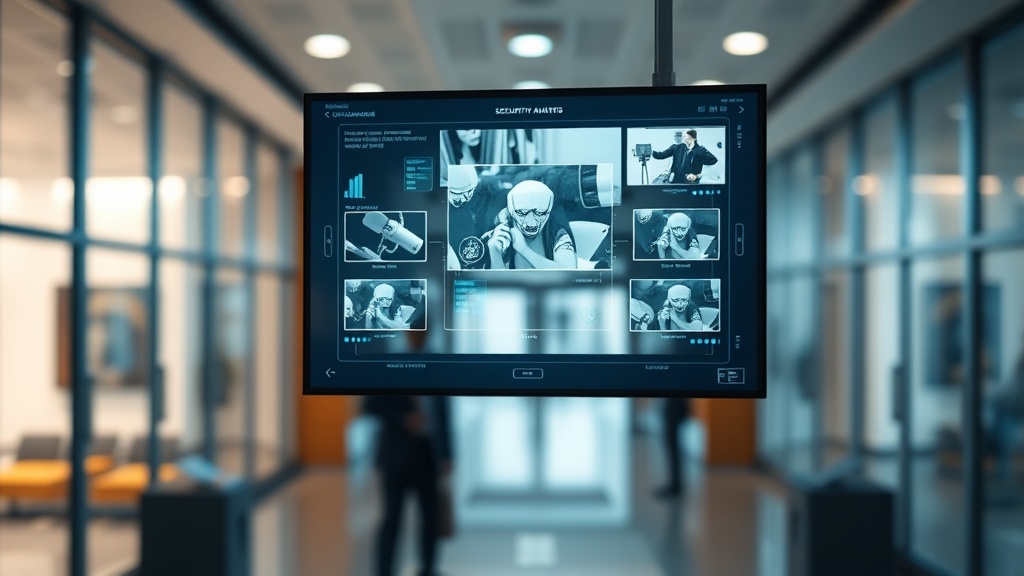
Why cameras need intelligence
Conventional CCTV is a "just in case" archive: events are found after the fact by scrolling through footage. Analytics changes the cameras' role: the system itself notices a crossed line, a face from a stop list or a car missing from the whitelist — and raises the alarm at the moment of the event, not the next morning.
An honest fact: an operator stops noticing what happens on the monitors after about twenty minutes of watching. Algorithms do not tire — they filter the stream and show a person only what needs a decision.
Facial recognition: access and lists
In access control a face works as a contactless pass: the terminal tells a live face from a photo and passes an employee in a fraction of a second. In security it is a list filter: the system checks faces against "unwanted" and VIP databases and quietly notifies the guards or a manager.
For banks and retail it is a working tool — from fraud prevention to personally greeting an important client. The technical basis matters, without illusions: besides the biometric template, Hikvision and ZKTeco terminals also keep the photograph taken when the person was enrolled. A recognition database is therefore not a set of anonymised numbers but personal data in full, and it has to be handled accordingly.
Analytics for business and security
Retail gets numbers the till does not have: visitor counting and conversion, floor heat maps — where shoppers linger and which shelves they bypass — and queue alerts when it is time to open another till. Marketing gets data for decisions instead of hunches.
For security, analytics closes the perimeter: a virtual line on the image replaces kilometers of sensor cable, while object classification algorithms — AcuSense in Hikvision's range, WizSense in Dahua's — tell a person from a dog or a swaying branch, leaving an order of magnitude fewer false alarms than plain motion detection. Abandoned object and loitering detection completes the picture in malls and at stations.
Camera or server — and how to start
Modern Hikvision and Dahua cameras carry the basic algorithms on board — perimeter and detection need no server. Recognition against large face databases, counting across a store chain and complex scenarios call for an AI server platform. We price both options: in an upgrade project the analytics usually comes from swapping the key cameras for models that carry the required algorithms, and a server is added only where a large database makes it unavoidable.
We start with scenarios, not a price list: what must happen on an alarm, who gets the notification, which reports management needs. Then a pilot on one or two cameras, and rollout. Turnkey across Tashkent and all of Uzbekistan — with operator training, warranty and support.
Biometric storage and database access
Face templates are personal data and are better kept on site — on a server or recorder rather than in someone else's cloud. Before launch, decide who may add people to the database, how long events are retained, and how an employee record is deleted after dismissal.
Keep a separate audit log of administrator actions; it also protects the company in disputes. Employee consent to biometrics is put in writing, while for visitors detection without identification is usually enough.
FAQ
Can analytics be added to old cameras?
Technically server software analyses the stream from any camera of decent resolution, but the result is limited by the camera itself: resolution, angle, light sensitivity. We handle such a task as an upgrade: a site audit and a specification that replaces the key cameras and, where needed, adds an analytics server. The warranty covers the equipment we supplied and installed.
How many faces can the recognition database hold?
Terminals keep thousands of templates on board, server platforms hundreds of thousands. A 500-employee entrance runs fine on a terminal; site networks and big lists are a server's job.
Does recognition work with a mask or glasses?
Modern algorithms recognise a face in ordinary glasses and with partial occlusion; a medical mask reduces accuracy — for such conditions a second factor is configured: a card or a QR code.
What about privacy and legality?
Start from the fact that the database holds both the template and the enrolment photograph — that is, a body of personal data. Hence the requirements: written consent from employees, a limited circle of administrators, logged access, a defined retention period and deletion of the profile on dismissal. We help build that routine and draft employee and visitor notifications correctly.
Installation works cost calculator
Set the number of points — the calculator lays out a site plan and shows the range from our standard price list. One minute, no phone calls.
Related services
Catalog on the topic