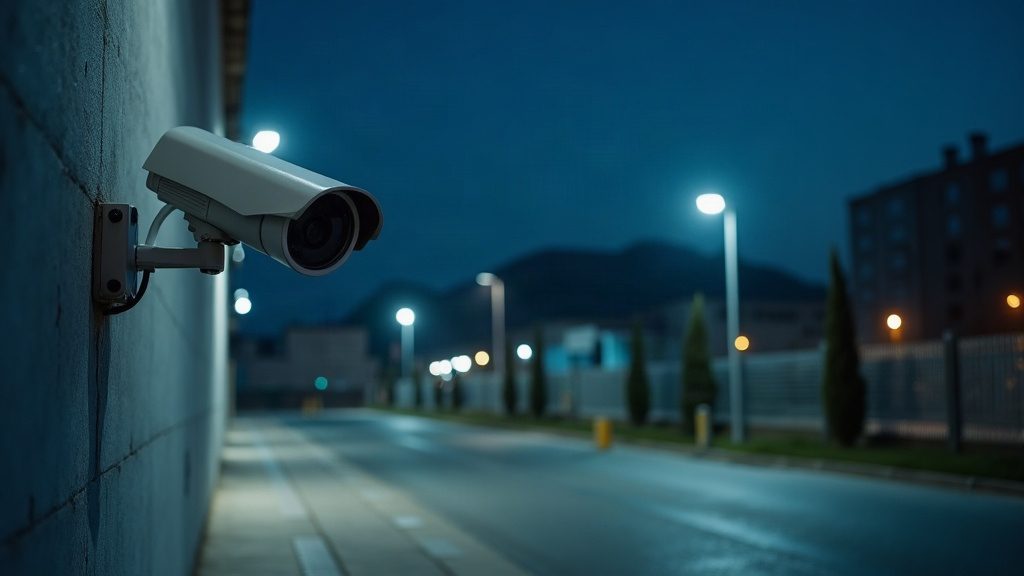
In short
- Ordinary motion detection reacts to any pixel change: shadows, branches, rain, headlights, animals.
- An AI camera first finds an object, then classifies it as a person, vehicle or other and alarms only on the chosen classes — all inside the camera.
- AcuSense (Hikvision): human/vehicle filter, archive search, Live Guard with strobe; NXI recorders add AI to ordinary cameras.
- WizSense (Dahua): SMD Plus and Perimeter Protection; AS/PV models with active deterrence; in 2025 cameras on large models appeared for long perimeters.
- AI cameras cost 30–60 % more than ordinary ones and pay back in guard and search time; the right lens, height and zones matter more than the model.
Why an ordinary camera wakes you up at night
Classic motion detection compares consecutive frames and counts how many pixels changed. Above the threshold, it raises an alarm. The camera does not care what moved: a person by the fence, a cloud shadow, a branch in the wind, raindrops, headlights on a wall, a cat in the yard or a moth drawn to the infrared light right in front of the lens.
As a result, a homeowner gets dozens of notifications a night, a warehouse guard learns to ignore alarms, and the archive fills with events in which the real one cannot be found. Lowering sensitivity means missing a person who walks slowly or far away. This is exactly the problem cameras with on-board analytics solve.
How an AI camera knows there is a person in the frame
The camera has a dedicated neural processor running a network trained on a large number of labelled frames. It works in two steps. First, the network finds a moving object in the frame. Then it classifies it: human, vehicle or other. The alarm rule fires only for the classes you selected.
Crucially, all processing happens inside the camera: no server, cloud or permanent internet is needed. The recorder receives a ready event tagged human or vehicle, and the phone app sends a notification with a snapshot. Classification also works at night in infrared mode, although accuracy in the dark depends on illumination and distance to the object.
Hikvision AcuSense: what it does and how to spot it in the model code
AcuSense is Hikvision's name for the technology. It adds a human/vehicle filter to ordinary motion detection (the manufacturer calls it Motion Detection 2.0) and to smart rules: line crossing, intrusion, region entrance and exit. Branches, shadows and animals are discarded, and only the chosen classes trigger alarms.
The second benefit is archive search. In the recorder or app you can filter footage: show only people at the gate last night. Minutes instead of hours of viewing. Models marked Live Guard (often /SL in the code) respond to an intruder themselves: they switch on a red-blue strobe and play a voice warning — in our catalogue, for example, the DS-2CD2087G3-LI2UY/SL.
In our catalogue AcuSense appears in the series 2 cameras (DS-2CD2xxxG2 and G3, for example the DS-2CD2043G2-LI2U), while the mass-market series 1 (DS-2CD1043G2-LIU) has simplified human and vehicle detection. For cameras without AI there is another route: Hikvision recorders with NXI in the model code (DS-7608NXI-K2, DS-7616NXI-K2) classify events from ordinary cameras themselves. The number of channels on which the recorder does this is limited — check the datasheet of the specific model.
Dahua WizSense: SMD Plus and perimeter protection
Dahua's equivalent line is called WizSense. The basic function is SMD Plus, smart motion detection: the camera analyses the object's shape and sends an alarm only when a person or vehicle is in the frame. It is enabled with a single setting, without drawing complex rules. In datasheets the manufacturer states an SMD Plus false-alarm rate of 1–2 %; this is a manufacturer claim, not an independent test.
For guarding a site there is Perimeter Protection — line crossing and intrusion with a filter that cuts out triggers from animals, leaves and glare. Models with active deterrence (AS or PV in the code) switch on a siren and lights when a rule is violated. In our catalogue this is, for example, the 8-megapixel Dahua IPC-HFW2849T-AS-IL.
Junior Dahua series have reduced or no classification, so when choosing, look for the SMD Plus and Perimeter Protection lines in the datasheet, not just the resolution.
What is new in 2025: large models in cameras
The next step is cameras running large neural models trained on far more data. On 1 July 2025 Hikvision released the DeepinViewX series based on its Guanlan models: analytics work at up to 60 metres at night on some models and up to 120 metres on triple-lens versions. The manufacturer claims up to 90 % fewer false alarms than conventional AI cameras, based on its own lab tests.
In March 2025 Dahua presented the second version of its Xinghan models and refreshed the line in September. Such cameras distinguish people and vehicles more accurately at long range, in rain and in difficult light, but they belong to the project segment: long perimeters, industrial sites and warehouses. For a home, shop or office, mass-market AcuSense and WizSense are enough.
How to set it up so the AI does not make mistakes
The network sees only what the lens gives it. A person must occupy enough of the frame: a camera with a 2.8 mm lens should not cover a 60-metre perimeter — it will see the far end but not classify it. Mounting height is usually 2.5–4 metres, angled so that a person is seen full-height rather than from above.
Rule zones are drawn only where an intruder can actually pass: the road beyond the fence and the neighbour's yard are excluded. The camera is not pointed straight at the sun or street lights. Spider webs in front of the lens glow under infrared at night and disrupt analysis, so cameras are cleaned every season.
After installation the system is tested live: a person walks through the zones by day and by night while the engineer checks which events arrived and with which tag. This catches blind spots and unnecessary rules before you start relying on notifications.
Where it pays off and where it is not needed
A private house: the phone notification arrives only when there is a person in the yard, not a cat or a branch. A warehouse or construction site at night: security gets real alarms, and a strobe camera scares off an intruder before anyone arrives. A shop or office: searching the archive for people at the entrance after closing takes minutes. A residential complex: perimeter and parking with a vehicle filter.
Where AI is not essential: a camera above the till, in an office corridor or in a classroom, where footage is viewed only when investigating an incident. There, resolution, audio and archive matter more, and classification simply goes unused. A sensible design is AI on the perimeter and entrances, ordinary cameras inside, and a recorder that can search by person and vehicle.
What AI cameras cost
Prices from our catalogue as of 30 October 2026, subject to change: a 4 MP bullet with human and vehicle detection, Hikvision DS-2CD1043G2-LIU, from 568,900 UZS; a 4 MP AcuSense DS-2CD2043G2-LI2U from 908,900 UZS; an 8 MP AcuSense camera with colour night vision, strobe and voice, DS-2CD2087G3-LI2UY/SL, from 2,164,900 UZS; Dahua IPC-HFW2849T-AS-IL 8 MP from 1,225,900 UZS; an 8-channel AcuSense recorder DS-7608NXI-K2 from 1,484,900 UZS.
The difference from an ordinary camera of the same resolution is usually 30–60 %. It pays back in time rather than money: fewer wasted security call-outs, fewer hours of archive review and less chance of missing the real event among a hundred false ones. You can choose cameras and rules for your site on our CCTV or video analytics page — we return a quote within one business day.
Product from this article
- Hikvision DS-2CD2043G2-LI2U 4 MP AcuSense bullet cameraPrice and specifications in the catalog →
- Hikvision DS-2CD2087G3-LI2UY/SL 8 MP AcuSense camera with strobe and voicePrice and specifications in the catalog →
- Dahua IPC-HFW2849T-AS-IL 8 MP bullet cameraPrice and specifications in the catalog →
- Hikvision DS-7608NXI-K2 8-channel AcuSense NVRPrice and specifications in the catalog →
FAQ
Can AI be added to cameras that are already installed?
Yes, through a recorder with analytics: for Hikvision these are models with NXI in the code (AcuSense), for Dahua recorders with SMD Plus. They classify events from ordinary cameras, but on a limited number of channels — stated in the recorder's datasheet.
Does the camera tell a cat or dog from a person?
Yes, animals fall into the other class and do not trigger alarms. Mistakes are possible when the object is far away, poorly lit or partly visible, so the right lens and mounting angle matter.
Does the AI work at night?
It works in infrared mode and with colour illumination. Night accuracy depends on lighting and distance: the datasheet states the range at which the camera reliably classifies a person.
Is a server or internet connection needed?
No. Analysis runs inside the camera or recorder. Internet is needed only for phone notifications and remote viewing.
Does such a camera recognise faces?
No, AcuSense and WizSense determine the object class — person or vehicle — but do not identify a specific person. Face recognition is a separate function and separate cameras; see our article on video analytics and face recognition.
How many fewer false alarms will there be?
Manufacturers quote figures from their own tests: Dahua states 1–2 % false alarms for SMD Plus in datasheets, Hikvision up to 90 % fewer false alarms for DeepinViewX compared with conventional AI cameras. In practice the result depends on how zones, height and lighting are set up.
Installation works cost calculator
Set the number of points — the calculator shows the price range from our standard price list. One minute, no phone calls.
Read also
 Video Analytics and Facial Recognition: What Smart Cameras Can Do
 How to Choose a CCTV Camera: Resolution, Lens, Night Vision
 Cameras in Private Schools and Kindergartens from 1 July 2026: Audio, Online Viewing and a 6-Month Archive — What Is Required and How to Comply
 Hikvision or Dahua for an Enterprise: How to Choose a Platform for a Site with Dozens or Hundreds of Cameras
Related services
Catalog on the topic