In short
- For an enterprise you choose a platform, not a camera: the video management system, integration with access control, intercom and time attendance, analytics, compatibility with equipment already installed, and procurement rules.
- Both brands cover the full stack — cameras, recorders, central platforms, access terminals and intercoms — so the decision is made with a weighted criteria table and a pilot on the site's own scenes.
- If the purchase falls under the Law on Public Procurement, the specification is written brand-neutral: a specific model may be named only with the words «or equivalent» (Article 34 of ZRU-684).
How is choosing a brand for an enterprise different from choosing one for a home?
For a flat, a house or a shop with 4–8 cameras, the «Hikvision or Dahua» question is almost always settled by the price and specifications of a particular model — we covered that case in the article «Hikvision or Dahua: which to choose for video surveillance». At a factory, a warehouse complex, a business centre or a branch network the task is different. The system is built in phases and grows for years; turnstiles, intercoms, panic buttons and a video wall are connected to it, and dozens of users with different rights work in it. A mistake here costs not the price difference of a camera but a rebuild of the whole platform.
That is why a corporate choice starts with questions about the system rather than the picture. How many recorders and sites will there be? Who watches video, and from where? Is a single credential database shared with access control needed? Which events must reach security, and who responds to them? How will the site grow in two or three years? Both brands have cameras that fit these answers, and both are in the satsolutions.uz catalogue of more than 2,500 items: our own warehouse in Tashkent, fast-moving items in stock.
What management platforms do Hikvision and Dahua offer, and when do you need a server?
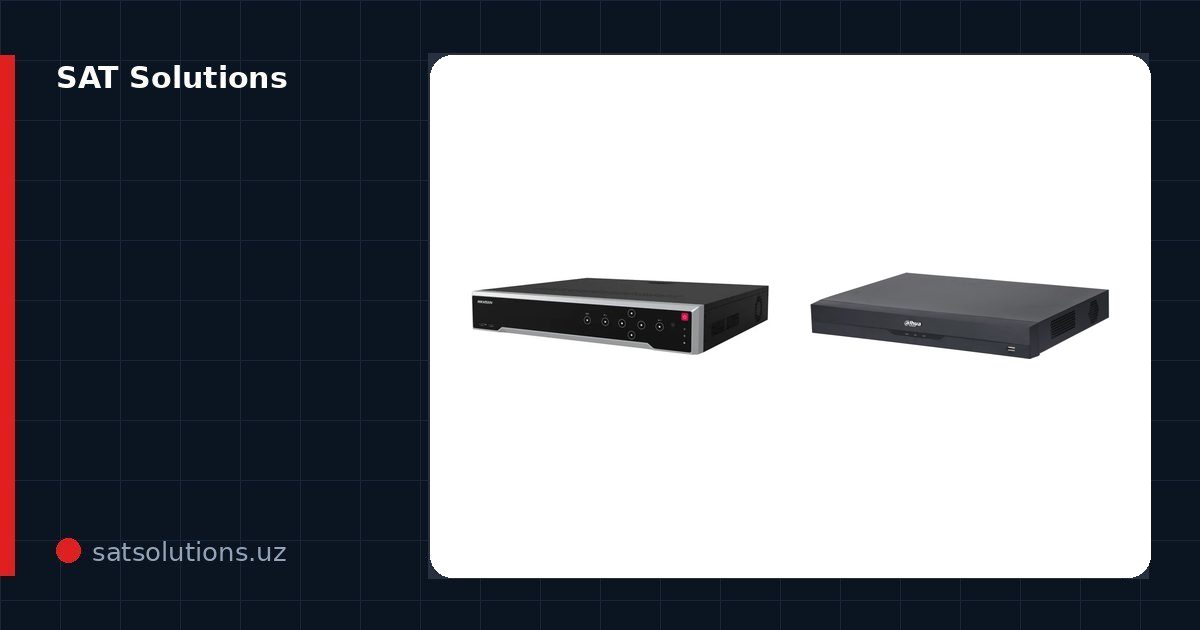
A small system lives on a network video recorder (NVR): it records the archive, shows cameras on a monitor and streams them to a mobile app. One 32-channel recorder covers a typical building or warehouse. For example, the Hikvision DS-7732NI-K4 costs 2,474,900 UZS and the Dahua DHI-NVR5232-EI 3,394,900 UZS (satsolutions.uz catalogue prices as of 09.11.2026, subject to change). They are different models with different feature sets, so comparing their prices directly is misleading: you compare configurations built for the same task.
Once there are more than one or two recorders, or branches, a video wall, an operator action log and access roles appear, you need a central platform — video management software (VMS) on a dedicated server. For Hikvision this is HikCentral Professional; for Dahua it is DSS Pro and the DSS-OneBox hardware-software server (the DSS-OneBox-H1/128 costs 20,374,900 UZS, catalogue price as of 09.11.2026). According to the manufacturers, such platforms unite recorders and cameras across sites, store events, manage users and connect access control and intercom modules. We supply HikCentral Professional and configure it for the site's setup. On Dahua DSS Pro, for example, we deployed a system of 150 body-worn cameras for staff on duty — the case is published in our portfolio.
Signs that it is time to plan a platform (the thresholds come from our engineers' experience): more than 64 cameras or two recorders; several buildings or cities; an operator post with a video wall; different access levels (security sees everything, a shop-floor manager sees only their area); a requirement to log who viewed what; integration with turnstiles and time attendance. If at least three of these six points apply to your site, compare platforms, not cameras.
| Parameter | Network video recorder (NVR) | Central platform (HikCentral Professional, DSS Pro) |
|---|---|---|
| Scale | 32–64 channels per device | dozens of recorders and several sites |
| Users | basic accounts | roles, groups, action log (per the manufacturer) |
| Integration | alarm inputs and outputs | access control, intercom, video wall modules (per the manufacturer) |
| Runs on | the device itself | a dedicated server or an all-in-one server (OneBox) |
| Enough when | one building, one security post | several buildings, branches, an operator centre |
What matters more for an enterprise: the camera or the ecosystem?
On a corporate site, the ecosystem. If the building already runs access terminals, intercoms or recorders of one brand, it makes sense to build the next CCTV phase in the same ecosystem: one platform, one user database, access events and video in one operator window. Switching brands is justified when the old fleet is being replaced entirely anyway, or when the other brand covers a task the current one handles less well.
Look at the subsystems you will need in two or three years: a turnstile checkpoint, face-based time attendance with timesheet export to 1C, visitor passes, intercom. Both brands have their own face recognition terminals and access controllers — for example, the Hikvision DS-K1T343EWX terminal costs 1,137,900 UZS (catalogue price as of 09.11.2026). For access control and time attendance, enterprises also consider a separate ZKTeco line — it is also in our catalogue; we compared them in the article «ZKTeco or Hikvision: biometrics for access control and time attendance». In that case the video–access link is checked separately, already at the specification stage.
How do you compare Hikvision and Dahua analytics without overpaying?
Both brands' analytics solve one basic task: telling people and vehicles apart from shadows, branches or animals. Hikvision calls the technology AcuSense, Dahua calls it WizSense; how they work is explained in detail in the article «AI in the camera: how AcuSense and WizSense tell a person from a cat and a car». For an enterprise this means, above all, fewer false alarms on the perimeter and fast archive search: a query «people at the gate after 22:00» instead of hours of footage.
People usually overpay in two cases. First, cameras with analytics go where footage is watched only when investigating an incident: a corridor, the accounts office, a finished-goods store. Second, face or licence-plate recognition is bought without a described scenario: who receives the event and what they do with it. A working rule: analytics on the perimeter, entrances and gates; ordinary cameras indoors; face and plate recognition only for a specific process such as a checkpoint or plate-based vehicle entry.
Can you mix Hikvision and Dahua on one site?
You can, with limitations. Cameras of both brands support the ONVIF standard, so video streaming and recording work on a recorder or platform of the other brand. Brand-specific functions — person/vehicle classification as an event, smart archive search, configuring analytics rules from the platform — work fully in the native ecosystem, while over ONVIF they are passed partially or not at all. The standard has a separate profile for analytics metadata, but its support should be checked for each camera–recorder pair before purchase, not after installation.
A practical scheme for an operating enterprise: the new phase is built in one brand together with the platform, and older cameras of the other brand are connected via ONVIF as «plain video» until their scheduled replacement. Mixing brands within one new phase without a reason does not pay off: the saving on a single model is eaten by configuration time and troubleshooting incompatibilities.
How do you take procurement rules into account when choosing a brand?
The Law of the Republic of Uzbekistan No. ZRU-684 of 22 April 2021 «On Public Procurement», Article 34, part three (as amended by ZRU-1005 of 27 November 2024, in force since 1 March 2025), prohibits including a trademark, model, manufacturer or source of origin in a procurement description. The exceptions are purchases through the electronic shop and cases where there is no other sufficiently precise way to describe the goods; then the description must include the words «or equivalent», except where goods are incompatible.
For brand selection this means two things. First, the specification describes characteristics and functions — resolution, codec, analytics, platform integration, archive depth — not a brand, and any suitable system can win. Second, when expanding an existing system, the incompatibility exception makes it possible to justify the same brand if new cameras must work with the platform already installed and its analytics; this justification is written into the specification. The law keeps being amended, so check the version in force on the date of the specific purchase.
How do you ensure cybersecurity and firmware updates?
Both brands have had published firmware vulnerabilities — for example, CVE-2021-36260 for Hikvision and CVE-2025-31700 and CVE-2025-31701 for Dahua — and both released fixes. For an enterprise the right question is not «which brand is safer» but «who maintains the system and how»: a firmware update routine, a separate network (VLAN) for cameras, closed ports, remote access via the manufacturer's cloud or a VPN, personal accounts instead of one shared login. Details are in the article «How to protect IP cameras and a recorder from hacking».
The second question is where the data is stored. Under Article 27-1 of the Law «On Personal Data» No. ZRU-547 (as amended by ZRU-1125 of 26 March 2026), biometric data must be stored on the territory of Uzbekistan. Face templates in access terminals are biometric data, so the platform server holding the face database is placed in Uzbekistan. For an ordinary video archive this article gives no direct instruction, but keeping it on your own server or recorder in the country is the safest option.
How do you make the decision: a criteria table and a pilot
To keep the choice from becoming a debate about taste, calculate it. Give each criterion a weight according to its importance for your site (totalling 100), score each brand from 1 to 5, multiply the score by the weight and add up the points. Sample weights are below — yours will differ.
| Criterion | What to check | Sample weight |
|---|---|---|
| Management platform | scale, roles, video wall, action log | 20 |
| Integration with access control, intercom, time attendance | required modules in one platform | 15 |
| Existing fleet | what is already installed and will keep working | 15 |
| Total cost of ownership | cameras, platform, licences, disks and works over the whole lifetime | 15 |
| Analytics | person/vehicle, archive search, faces and plates for a scenario | 10 |
| Range of required models | outdoor, long focal length, panoramic, with microphone | 10 |
| Updates and security | firmware regularity, centralised updates | 10 |
| Procurement requirements | «or equivalent», compatibility justification | 5 |
Then run a pilot. We also run pilots and demonstrations on the customer's site using the same method:
- Pick 2–3 typical scenes on the site: vehicle entrance, perimeter at night, a workshop or a warehouse.
- Install 2–4 cameras of each brand of the same class and resolution on every scene.
- Record both groups to their own recorders with identical codec and bitrate settings.
- Let the system run for two weeks in the site's normal mode.
- Compare night images, the number of analytics false alarms, ease of archive search and the actual recording volume per day.
- Enter the results into the criteria table and only then calculate the full estimate.
An integrator is chosen the same way — by its experience with both brands' platforms and by the pilot results. Both brands are in the SAT Solutions catalogue; we supply and configure HikCentral Professional, and for Dahua we hold the «Authorized Strategic System Integrator» certificate for 2026 (valid 01.01–31.12.2026, shown on the «About» page).
About the company
- SAT Solutions is a brand of SUPPLY AND TRANSPORTATION LLC (TIN 308603912). Tashkent, 5 Katta Darkhon Street; +998 97 862-66-99; sales@satsolutions.uz; Mon–Fri 9:00–18:00.
- Equipment supply and installation: video surveillance, access control and turnstiles, time attendance, intruder and fire alarms, intercom, structured cabling and LAN, Wi-Fi, fibre optics, server rooms. Installation by our own staff: 3 engineers and 15 installers.
- satsolutions.uz catalogue: more than 2,500 items, including Hikvision, Dahua and ZKTeco; prices in UZS including VAT. Our own warehouse in Tashkent, fast-moving items in stock.
- We supply both brands — Hikvision and Dahua; the Dahua «Authorized Strategic System Integrator» certificate for 2026 (valid 01.01–31.12.2026) is on the «About» page.
- Documents on the «About» page: National Guard permit No. 1554491 (installation, commissioning and maintenance of security equipment); Ministry of Emergency Situations permit No. 913518 of 23 July 2025 (installation, commissioning and maintenance of fire alarm and automatic fire extinguishing systems) — under the notification procedure of Cabinet of Ministers Resolution No. 88 of 25.02.2022.
- 3-year warranty on installation works; equipment carries the manufacturer's warranty of 1 to 3 years. We work with VAT; e-invoices (ESF) are issued through an electronic document-exchange operator.
- Send your specification to sales@satsolutions.uz — we will prepare a quotation with an equipment specification and a schedule of works; quotations within 24 hours.
Product from this article
FAQ
Which is better for a factory — Hikvision or Dahua?
There is no universal answer: both brands cover cameras, recorders, platforms and access control. The decision rests on the existing fleet, the required platform and integrations, total cost of ownership and procurement rules — these go into a weighted table and are tested with a pilot.
When is a recorder no longer enough and a central platform needed?
In our engineers' experience, usually when there are more than 64 cameras or more than two recorders, several buildings, a video wall, access roles, an operator action log or integration with turnstiles. If three of the six signs apply, plan a platform.
HikCentral or DSS — what is the difference?
These are the central platforms of Hikvision (HikCentral Professional) and Dahua (DSS Pro, DSS-OneBox). According to the manufacturers, both unite recorders, users and events and connect access control modules. The differences lie in the module set and licensing terms; compare them using the current specification for your configuration.
Can Dahua cameras be connected to a Hikvision recorder, and vice versa?
Yes, video and recording work via the ONVIF standard. Brand analytics and smart search work fully only in the native ecosystem, so it is better to build a new phase in one brand.
Can a tender specify a particular camera brand?
Under Article 34(3) of Law No. ZRU-684, a public procurement description does not include a brand or model unless there is no other precise way to describe the goods — and then only with the words «or equivalent». The exception is incompatibility, for example when expanding an installed system.
Where must an access control face database be stored by law?
In Uzbekistan: Article 27-1 of Law No. ZRU-547, as amended on 26 March 2026, requires biometric data to be stored on the territory of the republic. The platform server with the face database is installed in the country.
Why do 32-channel Hikvision and Dahua recorders cost differently?
In the catalogue as of 09.11.2026 the DS-7732NI-K4 costs 2,474,900 UZS and the DHI-NVR5232-EI 3,394,900 UZS, but they are different models with different functions. Compare complete configurations for one task, not the prices of individual devices.
Installation works cost calculator
Set the number of points — the calculator shows the price range from our standard price list. One minute, no phone calls.
Read also
 Hikvision vs Dahua: Which to Choose for Video Surveillance
 How much does video surveillance cost for a 32-camera business, and what makes up the budget?
 AI in the Camera: How AcuSense and WizSense Tell a Person from a Cat or a Car — and Why False Alarms Disappear
 How to Protect IP Cameras and Recorders from Hacking: Passwords, Updates, VLAN — Lessons from the 2025 Vulnerabilities
Related services
Catalog on the topic