In short
- A facility fit-out is the supply of all equipment and materials for the low-voltage systems according to the customer's specification or working drawings, together with installation and commissioning when required.
- To get an accurate quotation, send a specification or bill of quantities with models or characteristics and quantities, floor plans, archive and integration requirements, and state whether installation is needed.
- The process then runs through a compatibility check, the quotation, a contract with the specification attached, delivery, installation and handover with acceptance certificates, e-invoices and as-built documentation.
What is a facility fit-out and how is it different from buying from a price list?
Buying from a price list means individual items: a camera, a recorder, a switch. A fit-out is the supply of everything a system needs to work at a specific site: equipment, cable, racks, power supply, consumables, software licences and, when works are ordered, installation, commissioning and handover documents. The key difference is responsibility: in a fit-out the supplier answers for the items being compatible with each other and for nothing being missing from the specification.
Four terms appear in every request. A specification is a list of items with model or characteristics, unit of measure and quantity. A bill of quantities (BOQ) lists works and materials with volumes: metres of cable, number of points, installation of each unit. Working drawings are the diagrams and plans the installation follows. A commercial proposal (quotation) is the supplier's reply with a price for every line of the specification.
Fit-outs are ordered by developers and general contractors handing over a building, by procurement managers of enterprises upgrading a warehouse, a workshop or an entrance checkpoint, and by installation contractors who do the works themselves and buy the equipment for a site in one package.
What should you send a supplier to get an accurate quotation?
The accuracy of a quotation depends on the input data. The minimum package is a specification and plans; everything else reduces clarifying questions and the risk of substitutions after the contract is signed.
| What to send | What it should contain | Why |
|---|---|---|
| Specification or bill of quantities (Excel or PDF) | model or characteristics, unit of measure, quantity for each system | basis for the calculation and line-by-line comparison of offers |
| Floor plans or working drawings | locations of cameras, readers, detectors, racks, cable routes | checking line lengths, port count and cable metres |
| Scope of works | supply only / supply and installation / installation and commissioning | defines the sections of the quotation and the document set |
| Archive requirements | recording depth in days, where the archive is stored | sizing disks and recorders |
| Existing equipment | brands, models, software platform | compatibility when extending a system |
| Site schedule | construction stages and deadlines for each system | delivery in batches to the schedule |
| Document requirements | contract, VAT, e-invoices (ESF), certificates of completed works, as-built documentation, customer forms | content of the closing package |
| Contact person | name, phone, e-mail | quick clarifications on the specification |
If there is no specification yet and only a task — "cover a 1,200 m² warehouse with CCTV" or "install an entrance with four turnstiles" — the work starts from that: an equipment list is drawn up from the plans and a site survey, and once agreed it becomes the specification attached to the contract.
Model or characteristics: how should specification lines be written?
For a corporate customer the simplest option is the exact model and part number: offers from different suppliers can then be compared line by line. If a substitute is acceptable, list next to the model the parameters that make a substitute equivalent: resolution, lens and field of view, illumination range, enclosure protection class, codec, PoE power and, for a recorder, number of channels, number of disk bays and incoming bandwidth in Mbit/s.
For state customers the rule is set by law. Part three of Article 34 of the Law of the Republic of Uzbekistan No. ZRU-684 of 22 April 2021 "On Public Procurement" (as amended by Law No. ZRU-1005 of 27 November 2024, in force since 1 March 2025) does not allow a trademark, model or manufacturer in the description of a procurement, except for purchases through the e-shop and cases where the goods cannot be described precisely in any other way; in those cases the words "or equivalent" must be included, unless the goods would be incompatible. The law keeps being amended, so check the version in force on the procurement date.
Quantities are written in the units the goods are supplied in: cameras and recorders in pieces, cable in metres or 305 m reels, racks in pieces with the height in rack units. For recorders and switches it makes sense to plan a reserve of channels and ports straight away — about a quarter above the current need, which is how we plan it in our own specifications — so that the device does not have to be replaced when the system grows.
What is checked in a specification before pricing?
A specification error is most expensive after delivery, when the equipment is already on site. That is why the specification is checked against seven points before pricing.
- Camera and recorder compatibility: codec, channel count and incoming bandwidth. For example, the 32-channel Hikvision DS-7732NI-K4 recorder accepts up to 256 Mbit/s: 32 cameras at 4 Mbit/s take 128 Mbit/s, at 8 Mbit/s they take the whole bandwidth.
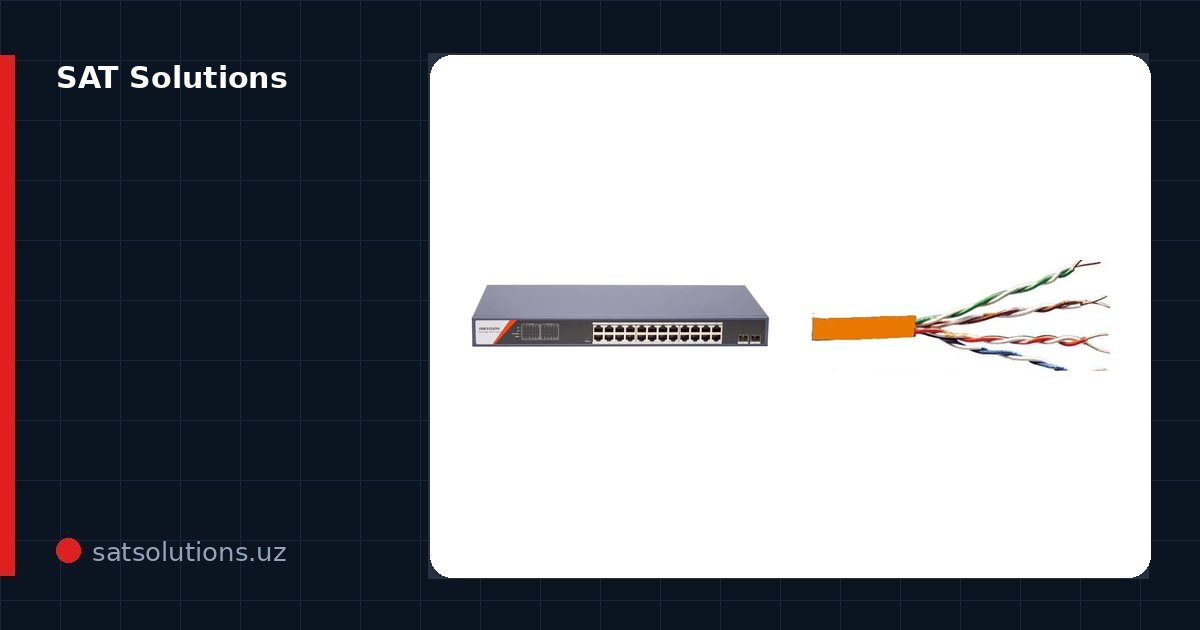
- PoE budget: the total consumption of the cameras on a switch is compared with its power budget — 370 W for the 24-port Hikvision DS-3E1526P-SI-24P2F.
- Line length: data and power over twisted pair reach up to 100 m from the switch; distant points need fibre or a remote switch.
- Disks: the number of recorder bays and the archive volume by the formula "bitrate × seconds per day × days ÷ 8".
- Power: an uninterruptible power supply for the rack with the recorder and switches.
- Cable and materials: metres, trays, conduit, connectors, patch panels — what is most often missing from an equipment specification.
- Software: channel licences for a central platform if the site is managed from a server, and integration with access control or time attendance.
For every discrepancy found, the supplier either asks a question or proposes an option and states how it differs from the original line. The decision stays with the customer, and the final specification is attached to the contract.
What stages does a facility fit-out go through?
- Request: specification, plans and document requirements — to sales@satsolutions.uz or via the "Supply and tenders" page.
- Review: checking the specification against the seven points, questions to the customer, a site visit if needed.
- Quotation: within 24 hours — price for every line, equipment and works separately, a list of what is not included.
- Contract: subject, specification as an annex, delivery, acceptance and warranty terms.
- Delivery: in full or in batches to the site schedule, with delivery notes and e-invoices.
- Installation and commissioning, if ordered: laying cable routes, mounting, configuration, testing every point.
- Handover: certificate of completed works, as-built documentation, transfer of accounts and passwords against signature, staff training.
- Warranty and maintenance: the manufacturer's warranty on equipment, the contractor's warranty on works and, if needed, a maintenance contract.
How long delivery and installation take depends on the volume and on how complete the specification is. Batch deliveries are agreed in advance so that equipment arrives when the related works start rather than sitting on a construction site for months.
Which documents does the customer receive?
| Stage | Document | Purpose |
|---|---|---|
| Pricing | Commercial proposal | budget approval, comparing suppliers |
| Contract | Contract and specification annex | fixes models, quantities, price and warranty |
| Payment | Invoice | basis for payment |
| Delivery | Delivery note and electronic invoice (ESF) | receiving the equipment, accounting and tax records |
| Delivery | Manufacturer's warranty cards, passports and manuals | warranty claims |
| Installation | Certificate of completed works | closing the works |
| Handover | As-built documentation: diagrams, equipment list with serial numbers, network addresses, accounts handed over against signature | operation and future extensions |
| At the customer's request | Forms under the customer's estimating rules (Form 2 and Form 3): resource statement and statement of the cost of works | submitting works to accounting or technical supervision |
SAT Solutions works with VAT: e-invoices (ESF) are issued through an electronic document-exchange operator, so the delivery can be booked without waiting for paper originals. Form 2 (resource statement) and Form 3 (statement of the cost of works) under the customer's estimating rules are issued at the customer's request. As-built documentation is handed over as follows: diagrams, an equipment list with serial numbers, network addresses, and accounts handed over against signature. Certificates of conformity and model passports are provided on request.
Supply only or supply with installation: which should you choose?
Supply without installation suits a customer or general contractor with its own installation team: it receives the equipment by specification and works to its own schedule. In this case the customer gets the manufacturer's warranty on the equipment of one to three years, while the on-site solution and installation quality are the responsibility of whoever installs it.
Supply with installation by one contractor puts responsibility in one pair of hands: whoever supplied the equipment also configures it, and a failure does not turn into an argument over whether the camera or the cable is to blame. SAT Solutions installs with its own staff — 3 engineers and 15 installers — and gives a 3-year warranty on installation works; the manufacturer's warranty of 1 to 3 years applies to the equipment.
| Criterion | Supply only | Supply and installation |
|---|---|---|
| Who is responsible for compatibility | the supplier for the specification lines, the installer for the on-site solution | one contractor for the whole system |
| Warranty | manufacturer's warranty on equipment, 1–3 years | manufacturer's warranty on equipment and 3 years on installation works |
| Documents | contract, delivery notes, e-invoices, warranty cards | the same plus certificates of works and as-built documentation |
| When it is chosen | own installation team or a general contractor | a finished system must be handed over as a whole |
How is the price of a fit-out formed?
The price has three parts: equipment, materials and works. Equipment is priced at catalogue prices on the date of the quotation: satsolutions.uz lists more than 2,500 items with prices in UZS (prices as of 9 November 2026), and fast-moving items are in stock at our own warehouse in Tashkent. We work with VAT. Materials — cable, trays, fixings, consumables — are priced from the bill of quantities, and this is exactly where specifications most often turn out to be incomplete. Works are priced at unit rates.
An example of SAT Solutions CCTV rates as of 9 November 2026: installing an indoor camera — 155,000 UZS, an outdoor camera — 180,000, camera configuration and commissioning — 77,000, installing and configuring a recorder for more than 16 cameras — 450,000 per system, cable laying — 7,000 UZS per metre inside a building and 10,000 along a facade or outdoors. On large sites cable routes often cost more than mounting the cameras: in the calculation for a 32-camera system, laying 1,440 m of cable accounts for about 11.5 million of the 19.8 million UZS of works, roughly 58%.
When comparing offers, look beyond the total. Ask how long the price is valid, whether materials and commissioning are included, how many days of archive the chosen disks provide and what is written under "not included". Median prices by equipment type and the cost of works for six typical sites are collected in the SAT Solutions price index.
About the company
- SAT Solutions is a brand of SUPPLY AND TRANSPORTATION LLC, TIN 308603912; 5 Katta Darkhon Street, Tashkent.
- CCTV, access control and turnstiles, time attendance, intrusion and fire alarm, intercom, structured cabling and server rooms: equipment supply and installation. Installation by our own staff: 3 engineers and 15 installers.
- National Guard permit No. 1554491 (installation, adjustment and maintenance of technical security equipment) and Ministry of Emergency Situations permit No. 913518 (installation, adjustment and maintenance of fire alarm and automatic fire extinguishing systems) — documents on the "About" page.
- 3-year warranty on installation works; the manufacturer's warranty of 1 to 3 years on equipment.
- Catalogue: more than 2,500 items with prices in UZS (prices as of 9 November 2026); own warehouse in Tashkent, fast-moving items in stock.
- We work with VAT; e-invoices are issued through an electronic document-exchange operator. Contacts: +998 97 862-66-99, sales@satsolutions.uz, Mon–Fri 9:00–18:00.
Product from this article
FAQ
Can I order a fit-out without installation?
Yes. Supply by specification is ordered separately from works: the equipment is supplied under a contract with the specification, delivery notes and e-invoices, and your installation contractor does the works. The equipment is covered by the manufacturer's warranty of 1 to 3 years.
What if there is no specification yet?
Start from the task and the floor plans. An equipment list and a bill of quantities are drawn up from them, and once agreed they become the specification attached to the contract.
Can the equipment be delivered in batches?
Yes, deliveries are often split by construction stage. The content and timing of each batch are fixed in the contract or the delivery schedule.
How should quotations from different suppliers be compared?
Line by line: model or characteristics, quantity, warranty, scope of works, cable metres, archive depth and the list of what is not included. Comparing only the totals without this is misleading.
Can a specific brand be named in the specification?
A corporate customer is free to name models. A state customer, under part three of Article 34 of Law No. ZRU-684, names a trademark or model only in exceptional cases and then adds "or equivalent", unless the goods would be incompatible.
Which documents does the customer's accounting department need?
The contract with the specification, the invoice, the delivery note, the electronic invoice (ESF) and, if works were performed, the certificate of completed works. SAT Solutions works with VAT and issues e-invoices through an electronic document-exchange operator.
What warranty applies to equipment and works?
The manufacturer's warranty of 1 to 3 years on equipment and a 3-year SAT Solutions warranty on installation works.
Installation works cost calculator
Set the number of points — the calculator shows the price range from our standard price list. One minute, no phone calls.
Read also
 How to Write a CCTV Technical Specification for a Tender: Structure, Parameters and Uzbek Regulations
 How to Choose a CCTV and Access Control Supplier in Uzbekistan: a Procurement Checklist and Document List
 SAT Solutions price index, September 2026: what makes up the budget for video surveillance, access control and fire alarms
 How to size a hard drive for CCTV
Related services