In short
- A smart lock recognises the owner outside (fingerprint, code, card, face), while the motor, battery and electronics sit on the inner side of the door.
- The lock warns about a low battery in advance; as a last resort there is a mechanical key and, on many models, an outside emergency power port.
- Fingerprint, code and card work without internet and during power cuts; internet is needed for remote opening and the log.
- Before buying, check the door: thickness, mortise mechanism type and space for the inner unit.
- Smart locks in our catalogue start at 729,900 UZS; the biometric ZKTeco HBL400 with face recognition costs 2,993,900 UZS (prices 02.11.2026).
How a smart lock opens the door
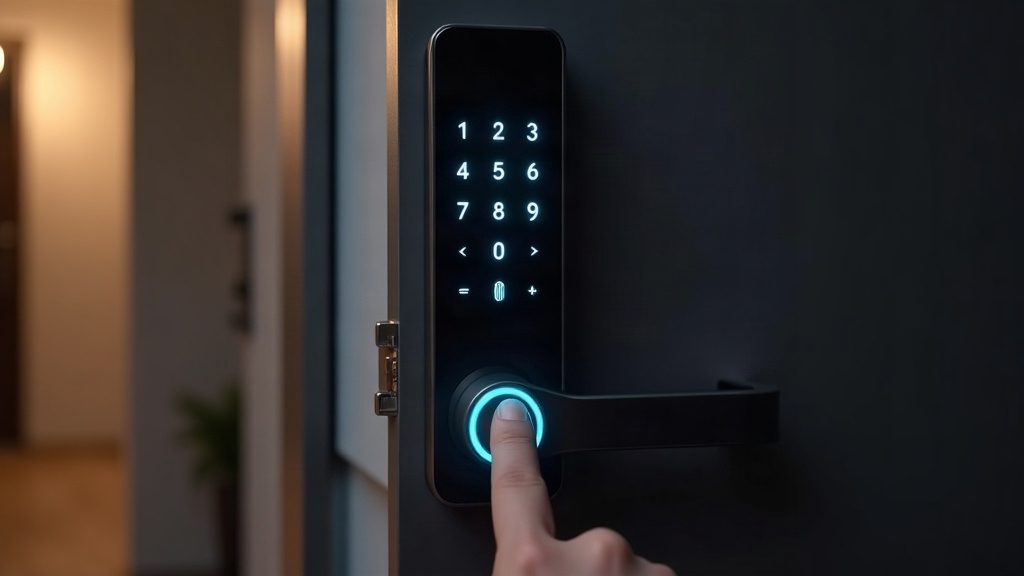
A smart lock has two parts. Outside is a panel with whatever recognises you: a fingerprint sensor, a keypad for a code, a card reader and, on some models, a camera for face recognition. Inside is a unit with the electronics, battery and a small motor that turns the bolt or lock mechanism. It recognises the owner — the motor unlocks; the door closes — the lock locks it by itself or at the press of a button.
So there is nothing outside that gives access to the controls: the battery and motor sit on the inner side of the door. A mechanical key remains as a backup: most models have an ordinary cylinder hidden under a cover on the outer panel.
How the lock recognises a finger, a code and a phone
Fingerprint sensors in locks are usually capacitive: they read the ridge pattern through the electrical properties of the skin rather than from an image, so a photo of a finger will not fool them. For example, the KANIHAD TK-606A-TW stores up to 100 fingerprints, 100 cards and 100 codes.
A code is entered on the keypad; good locks block entry after several wrong attempts so the code cannot be guessed. Cards work like an office pass. The app opens the door over Bluetooth nearby or over the internet from afar, lets you give a guest a temporary code, and shows a log of who opened the door and when.
What happens when the battery dies
This is the main fear, and it is unfounded. The lock warns about a low battery in advance — with a signal on the panel and a notification in the app, usually weeks before the battery is completely flat. Battery life depends on the model and the number of openings: KANIHAD locks run on AA or AAA batteries, while the ZKTeco HBL400 has a built-in 4.2 Ah lithium-ion battery that is recharged rather than replaced.
If the warning is ignored, there are fallbacks: the mechanical key supplied with the lock and, on many models, an outside emergency power port — you plug in a power bank and open the door with a fingerprint or code. Whether a given model has this port is checked in the specifications before buying. Battery-powered locks simply get a fresh set of cells.
What happens without internet or mains power
A flat’s smart lock runs on its own battery, so a power cut in the building does not affect it. Fingerprint, code and card work locally, without internet: connectivity is needed only for remote opening, notifications and the app log.
Access-control locks powered from the mains behave differently: an electromagnetic lock opens without power and an electromechanical one stays locked, so they are installed with a power supply and battery. The difference between these types is covered in our article on choosing an electronic lock.
Will a smart lock fit your door
This should be settled before buying. Locks differ in design: some fit onto an existing mortise bolt, others replace the outer and inner trims completely and work with a specific type of mortise mechanism. Every model has a door thickness range: for example, the ZKTeco HBL400 is designed for doors 45–60 mm thick and the ZKTeco GL300W for glass panels of 10–12 mm.
Metal front doors often need their mounting holes adapted, and locks for glass doors have a design of their own. So an engineer first looks at the door or a photo of it: thickness, mortise lock type, opening direction and space for the inner unit. That way the lock fits first time and the door closes without effort — which determines whether the motor can lock it by itself.
What a lock offers beyond opening
Temporary codes are the main convenience for short-term rentals, cleaners, tradespeople and couriers: a code works during a set time and then stops by itself. The opening log shows when a child got home from school or when the housekeeper left. Auto-lock rules out “we forgot to lock it”: the lock locks the door by itself after a set time.
The lock is easy to tie into the rest of the home: open the door from the video intercom app, get a notification together with the alarm, add it to smart-home scenes. Locks with a Tuya Wi-Fi module, such as the KANIHAD TK-606A-TW, work in the shared Tuya ecosystem with sensors and sockets.
Which lock for a flat, a house and an office
Flat: a smart lock with fingerprint, code and mechanical key, chosen to fit your door. If you already run a Tuya smart home — a model with Tuya Wi-Fi; if long autonomy without changing batteries matters — a model with a built-in rechargeable battery. Private house: the same kind of smart lock on the front door, and an outdoor-rated electromechanical lock on the gate, opened from the intercom.
Offices and commercial premises: an electromagnetic or electromechanical lock with a card reader and an access-control system, where a departing employee’s access is revoked in one action. For a director’s office or server room — biometrics: the ZKTeco HBL400 recognises a face at up to 1 metre, plus fingerprint and card.
What smart locks cost
Catalogue prices on 2 November 2026, excluding installation: KANIHAD TK-606A-TW with fingerprint and Tuya Wi-Fi — 729,900 UZS; KANIHAD TK-605A with card and code — 741,900; KANIHAD TK-N1 Pro — 1,050,900; ZKTeco GL300W for glass doors — 1,558,900; KANIHAD TK-D1 Pro rated for 300,000 cycles — 1,607,900; the biometric ZKTeco HBL400 with face recognition — 2,993,900.
Installation cost depends on the door: on a prepared door the lock goes on in an hour or two, while a metal door with a non-standard mortise needs adapting. We choose a lock for your door from a photo, install it and set up the app for the whole family; our work carries a 3-year warranty. You can leave a request on our electronic locks page — we reply within one business day.
Product from this article
- ZKTeco GL300W smart lock for glass doors (fingerprint, code, card, smartphone)Price and specifications in the catalog →
- KANIHAD TK-D1 Pro smart lock (app, card, fingerprint, code, key)Price and specifications in the catalog →
- KANIHAD TK-606A-TW smart lock with Tuya Wi-FiPrice and specifications in the catalog →
- ZKTeco HBL400 biometric lock with face recognitionPrice and specifications in the catalog →
FAQ
Can a smart lock be opened if the battery is dead?
Yes: with the mechanical key supplied, and on many models by plugging a power bank into the outside emergency power port. The lock also warns about a low battery in advance.
Does a smart lock work without internet?
Yes, fingerprint, code and card work locally. Internet is needed only for remote opening, notifications and the app log.
Can the fingerprint sensor be fooled?
Capacitive sensors read the pattern through the skin’s electrical properties, so a photo or printout of a finger does not work. Good locks also block entry after several wrong attempts.
Will the lock fit a metal door?
Usually yes, but the door thickness, mortise lock type and space for the inner unit need checking. An engineer will assess the door from a photo and suggest a model.
Can I give a guest temporary access?
Yes, the app creates a code with a limited validity period: it stops working by itself at the set time.
How long do the batteries last?
From several months to a year, depending on the model and number of openings. The lock warns about a low battery in advance, so batteries are changed on its signal rather than blindly.
Installation works cost calculator
Set the number of points — the calculator shows the price range from our standard price list. One minute, no phone calls.
Read also
 Electronic door lock: magnetic, coded or smart — which to choose
 What Makes Up the Price of a Door Lock: Electronic, Coded and Smart
 Video Intercom for a Flat and an Entrance: 4-Wire, 2-Wire, IP or SIP — How It Works and How to Get Calls on Your Phone
 Smart Home: Where to Start and What Not to Get Burned By
Catalog on the topic