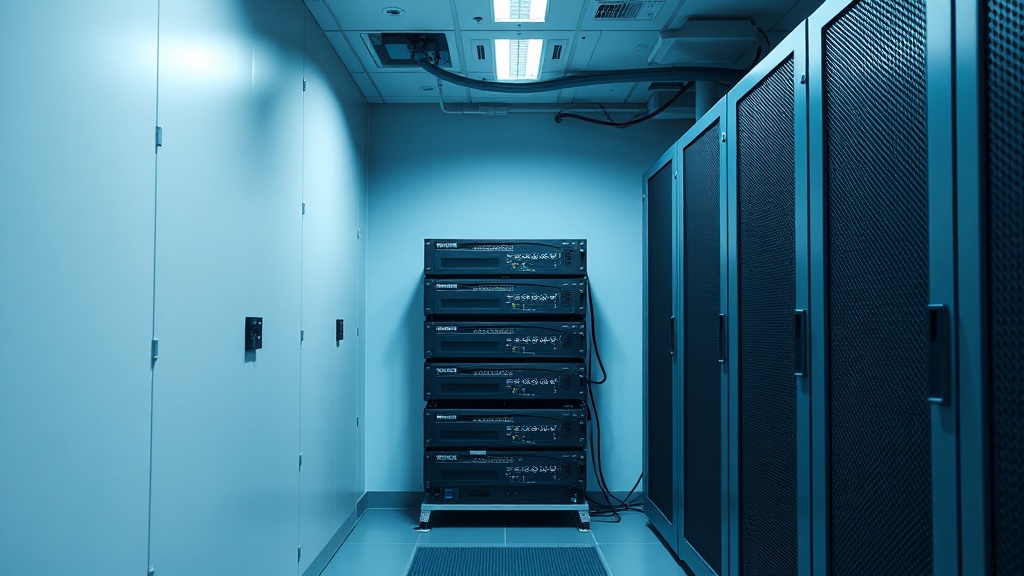
The room: where a server room does not belong
A server room does not belong under water or heating pipes, next to wet areas, or on the sunny side without cooling. The classic of the genre is a server in the accounting office under an archive shelf, or in the cleaner's closet: it works until the first leak or the first summer. The right room has no windows (or bricked-up ones), floor load margin, and service space in front of and behind the racks.
The minimum area follows the cabinet count: even one cabinet needs its doors to open 120° and a technician to stand on both sides. Crampedness means no serviceability — and that means downtime where half an hour of work would have sufficed.
Power: how many minutes will you survive
Server room electrics start with a dedicated feed and panel: servers must not share a line with the kettle and the office air conditioners. The UPS is sized by capacity and runtime, and the right question is "how many minutes do we need": a typical office server room needs 15–30 minutes for a clean shutdown, while critical services need hours and a diesel generator.
UPS batteries live 3–5 years and die quietly: you find out during an outage, when the backup holds seconds instead of minutes. Scheduled battery replacement is cheap insurance against the most annoying kind of downtime.
Cooling and fire suppression
A rack of servers heats like several space heaters — all year round, winter included. A household wall split is not built for this: it cannot cool in frost and has no rotation. The answer is a pair of inverter or precision units with automatic rotation and standby, with temperature and leak sensors wired into monitoring with phone alerts.
Extinguishing a server room with water or powder means finishing off what did not burn. The right answer is gas suppression: the agent displaces oxygen and leaves no trace on the equipment. It is complemented by early smoke detection and automatic ventilation shutdown.
Access, order and documentation
The server room door is closed with logged access control: "who entered the racks and when" is a question the IT director must be able to answer. Inside — the order that saves hours in every incident: cable management, line labeling, cable journals, a layout diagram.
We design and build server rooms turnkey: the room, electrics with UPS, cooling, gas suppression, access control and monitoring — and modernise live rooms without stopping services. The survey is free; we work across Tashkent and all of Uzbekistan with a warranty and service support.
Monitoring temperature and alarms
A server room fails quietly: the air conditioner stops on Friday night and it is discovered on Monday, from overheated drives. The minimum sensor set is temperature in the cold and hot aisle, humidity, a leak detector under the raised floor and a door contact; all of them should report to Telegram or to the duty engineer's mailbox.
The UPS and the air conditioner are put on the network over SNMP so that remaining runtime and faults are visible before the load drops. A trend threshold is worth setting as well: a 5 °C rise in half an hour is already a reason to drive out, without waiting for the alarm value.
FAQ
Can a cabinet replace a separate room?
For a small office — yes: a server cabinet with a UPS and ventilation in a shared room. The boundary is heat and noise: from two or three servers up, you need a separate room with proper cooling.
What temperature should a server room keep?
The working range is 20–25 °C with stable humidity. Stability matters more than the absolute value: temperature swings kill disks faster than a constant 27 does.
Why not install an ordinary air conditioner?
A household split is not made for 24/7 year-round duty and refuses to cool in frost. A server room needs units with a winter kit and rotation — otherwise the system greets January 1st with overheating.
What goes into server room monitoring?
The minimum: temperature in the hot and cold zones, humidity, leaks, UPS status and door opening. Alerts go to the duty engineer's phone. It is set up in a day and ends "we learned about the problem from the users".
Installation works cost calculator
Set the number of points — the calculator lays out a site plan and shows the range from our standard price list. One minute, no phone calls.
Read also




Related services
Catalog on the topic